Viticulturist David van Schalkwyk has spent more than a decade at Waterford developing a farming philosophy that places soil, roots and the wider ecosystem at the centre of the estate’s approach.
“We don’t farm with grapes, we farm with the roots and the soil,” David says.
It is a useful way of understanding The Jem. Its complexity does not begin in the cellar. It begins with the decision to plant a diverse collection of varieties in different parts of the estate, then understand how each responds to the farm's combination of granite, sandstone, clay, mountain slopes and maritime influence.
David’s approach is deliberately restrained. “We aim to intervene as little as possible, allowing nature to take its course,” he has said, explaining that the role of the vineyard team is ultimately to give the vines the best opportunity to express the environment around them.
The 2020 vintage is a particularly strong example of that relationship between place and season. Cooler conditions extended the ripening period, allowing the grapes to develop mature tannins and phenolics while retaining the structure required for long-term ageing.
The art is in bringing it together
Inside the cellar, every component of The Jem is initially treated as its own wine.
Approximately six months after fermentation, the individual components are brought together into the final blend. The blend is then aged for a further period, giving the varieties time to integrate and develop into a coherent whole. For the 2020 vintage, the wine spent 20 months ageing as a blend, in 225-litre and 300-litre French oak barrels, with 19% new oak.
For winemaker Jamie Papenfus, this is one of the most compelling parts of the work.
“For me, winemaking is more than a profession; it’s a way to integrate my love for nature with my passion for creation,” she says. “Working physically in the cellar and managing the winemaking process nourishes my soul.”
She particularly enjoys the intricacy of blending The Jem, a process that relies as much on accumulated knowledge as it does on instinct. After years of working with the vineyards, the cellar team has developed an understanding of how each variety contributes to the final wine.
The result is not a checklist of eight varieties. It is one wine.
As Mark has previously put it, “It was as if everything clicked into place,” describing how Cabernet Sauvignon established the estate's identity while the other varieties became “brushstrokes,” adding depth, complexity, and pedigree to The Jem.
The box is part of the wine
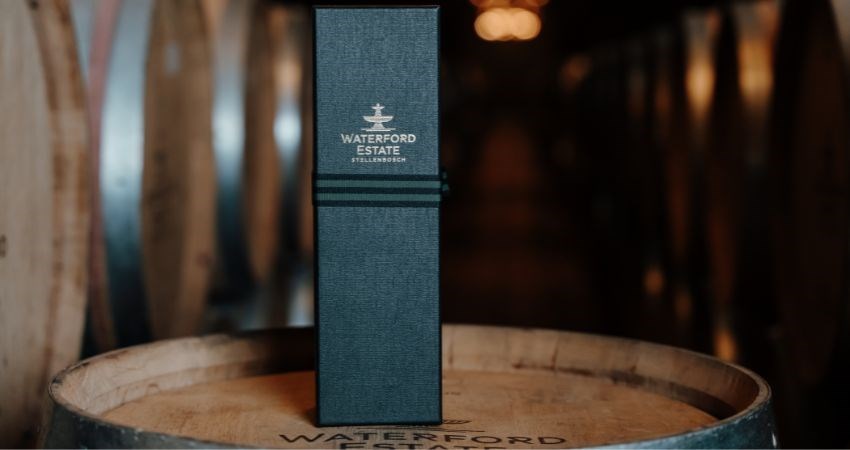
There is another element of The Jem that has become inseparable from the experience of the wine itself: the box.
The packaging is deliberately restrained. The bottle is presented as something to be discovered rather than simply unpacked.
To open a bottle of The Jem is to become a part of its journey.
The ribbon sealing each box is not decorative. It is there by design. Unique to its vintage, the ribbon and seal signify that the bottle has remained untouched since the day it left the cellar.
The collector becomes the first and only person to break the seal.
That moment belongs to them.
It is a small ritual, but one that reflects the philosophy behind the wine itself. Every detail has been considered with intention because The Jem is more than a bottle. It is the culmination of craftsmanship, patience, provenance, place and the people who have spent years learning how to translate Waterford Estate into wine.
The opening of the box is therefore not merely the beginning of drinking the wine. It is the final step in its journey from vineyard to cellar to collector.
The next chapter
The significance of releasing The Jem 2020 is not simply that another vintage has reached the market.
It is that we continue a project that began almost twenty years ago with a provocative question: could a South African wine demand a place at the international fine-wine table?
The answer has increasingly been found not in statements, but in the bottle.
The Jem has consistently earned international recognition, with the 2020 vintage earning 95 points in Tim Atkin’s 2025 South African Special Report. For Mark le Roux, however, the ambition extends beyond any single score, vintage or accolade.
“South Africa is one of the most diverse and interesting wine-growing regions in the world, and every wine brand and producer has their part to play. We’re determined to play ours.”
That may be the most appropriate way to understand The Jem today.
The wine was created to challenge perceptions of South Africa. It has evolved through changing vintages, hard-earned experience and a deeper understanding of the Helderberg.
At Waterford, the ambition is no longer simply to prove that South Africa can make fine wine.
It is to help define what South African fine wine can become.
The Jem 2020 is the latest expression of that ambition: a wine rooted in one estate, one mountain and one philosophy, but with its sights firmly set on the wider world.