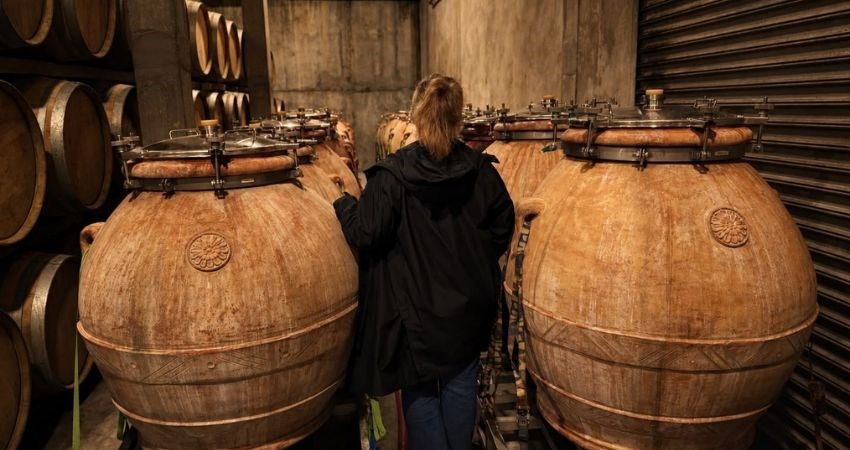
Terracotta amphorae have become one of the most intriguing tools in the world of modern wine. While they evoke images of Roman merchants and ancient Greek winemakers, they are by no means relics of the past. Today, some of the world's most thoughtful winemakers are rediscovering clay as a vessel capable of producing wines of remarkable purity and texture.
Kleine Zalze Wines in Stellenbosch has over the past two decades been a leader in the use of amphorae within the South African wine industry, with a collection of 24 Italian terracotta vessels each holding some 500 L of wine found within Kleine Zalze’s wine operations, one of the largest amphorae collections in any local cellar.
“We use handcrafted amphorae made by the Manetti family in Impruneta, Tuscany,” says Kleine Zalze winemaker Hanri Ferreira, who is the member of the winery’s team of four winemakers responsible for overseeing the fermenting and ageing of various wines in the clay vessels.
“These amphorae may look like cultural artefacts from another era, but they are incredible winemaking tools and have become an integral part of the Kleine Zalze ethos. Many of the white wines found in our range – especially Chenin Blanc and Sauvignon Blanc - contain a portion of wine that has been matured in amphorae, adding a dynamic dimension to the final blend. And we have been using red wines matured in clay in our Project Z line, underscoring the versatility of clay as an ageing vessel.”
At Manetti, where these amphorae are made, eight generations of artisans have worked with the region's famous terracotta clay and each vessel is made by hand. “That’s why, although they are sold as capable of holding 500 L of wine, the volume capacity may vary slightly as when crafting something of this nature, a human hand and eye cannot be constantly exact,” she says.
The appeal of an amphora as a winemaking tool, says Hanri, lies in what it doesn't do. “Unlike oak barrels, terracotta contributes no flavours of vanilla, toast or spice,” she says. “Unlike stainless steel, however, the amphora is not completely inert. Terracotta, especially that from the region in Tuscany from where Manetti sources its clay, is naturally microporous, allowing minute amounts of oxygen to pass through its walls. This gentle exchange of oxygen softens tannins, stabilises colour and slowly broadens the wine's texture, but without masking the fruit with wood character. It occupies an intriguing middle ground between barrel and tank.”
The clay itself is part of the story. The Impruneta region in Tuscany’s renowned terracotta contains abundant galestro, the same fractured schist found throughout the hills of the Chianti Classico wine region. Together with naturally occurring calcium carbonates and mineral salts, this clay gives the finished amphorae their characteristic permeability, while also providing exceptional mechanical strength and thermal stability. The thick four-centimetre walls buffer temperature fluctuations during fermentation and maturation, reducing the need for aggressive temperature control in the cellar.
The subtle oxygen transmission is one of the amphora's greatest virtues. While too much oxygen can diminish freshness, a minute amount can help a wine develop texture and complexity without compromising its fruit. The oxygen ingress through terracotta is significantly lower than that of oak, allowing the wine to evolve in a slow, measured way.
“Terracotta also possesses natural antimicrobial properties, which can reduce the need for sulphur additions to protect the wine during maturation,” says Hanri. “This offers us the opportunity to produce wines that retain freshness while relying less on intervention.”
The result is a wine with heightened purity of fruit. Because there is no overlay of oak character, the fruit appears more vivid and expressive. At the same time, amphorae maturation can enhance the wine's texture, adding palate weight and a gentle tactile richness without making the wine feel heavy.
“If there is one feature I pick up in a wine made in amphorae – besides texture and palate weight - it is a heightened sense of salinity,” says Hanri. “It is not that the wine tastes salty, but rather that it possesses the same effect that a perfectly seasoned dish has compared with one containing no salt at all. The flavours seem brighter, more focused and better defined, giving the palate greater energy and precision.”
To preserve this crystalline fruit expression, the lees are left undisturbed during the wine’s maturation in amphorae. “Rather than stirring the lees to build richness – as is the case with wines matured in tank or barrel - the aim when making wine in amphorae is to maintain pristine, bright fruit while allowing the vessel itself to contribute texture through its unique interaction with the wine. The result is a style that combines freshness, purity and finesse with an intriguing mouthfeel that is distinctive to clay.”
The proof of the pudding is in the tasting, and experiencing wines drawn directly from the amphorae gives one an insight into the way these vessels work with their liquid vinous hosts.
From one amphora, Hanri draws a Chenin Blanc from the Lyngrove region in Stellenbosch. The first impression is the absolute iridescent clarity of the unfiltered wines. Golden, clear and with a slight green tinge on the edge. And in the mouth, the textural and saline nuances are evident, coupled with beautiful white-fruit flavours. It is almost as if the linear focus from the clay ageing vessel has allowed the Chenin Blanc’s inherent fruit to be amplified.
The next amphora also contains Chenin Blanc. Although this hails from another Stellenbosch site, also coastal but slightly elevated. Here, the Chenin Blanc has a firmer, leaner and more mineral flavour profile due to its terroir typicity. Extraordinary: same grape, same ageing vessel, but two totally different wines.
A Sauvignon Blanc from amphora runs a clear, brisk line between breezy tropical fruit and a gravelly, salt-lick minerality, and an Alvarinho is cool crushed stone and fynbos.
On the red side, a Cabernet Sauvignon from Stellenbosch ageing in amphora shows a dimension of this variety that is totally unique as most Cabernet Sauvignons are matured in oak barrels. A clear run of dark fruit and pine-needle is apparent, with a clean finish on the palate that is truly delectable.
“Kleine Zalze’s experimental Project Z range plays a major role in identifying the potential of wines matured in amphorae suitable for using in our Kleine Zalze Family Reserve and Vineyard Selection wines,” says Hanri. “If you compare our Chenin Blanc and Sauvignon Blanc wines today to those made 15 years ago one would notice a difference in style, the wines being brighter, having greater clarity and exuding freshness as part of their layered complexity. This has a lot to do with the components of amphora matured wines finding their way into these Vineyard Selection and Family Reserve labels, and this has given Kleine Zalze wines a noticeably specific style, recognised by consumers and critics alike.”