Toasting to love and milestones with a glass of Champagne is a relatively ordinary, if elevated and delightful exercise. But it may soon seem as quaint and lovely, but as rare and incompatible with contemporary life as churning butter at home.
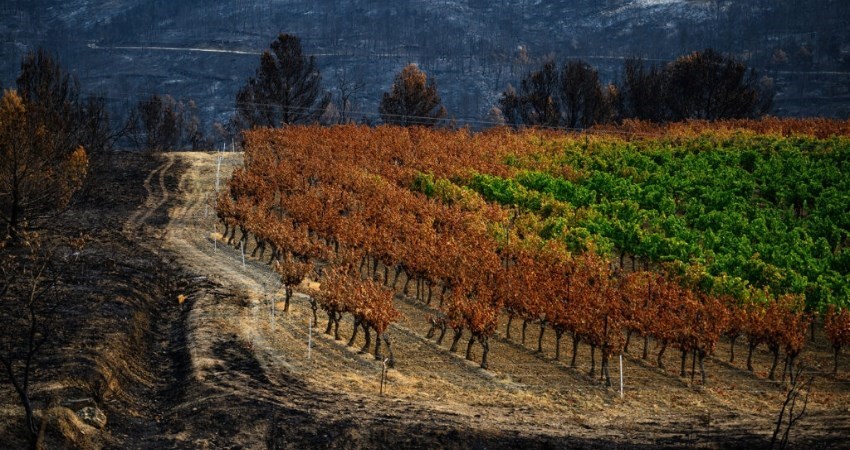
In France and Spain, major portions of wine country went up in flames this summer, echoing an all-too-familiar phenomena haunting countries around the world, every year. Hundreds of thousands of acres of land have been incinerated in Spain and France, with hundreds of thousands of people evacuated from their homes and land.
When it’s not on fire, it seems like wine country is contending with a deep freeze. This year alone, vineyards across the East Coast and France were devastated by surprise spring freezes and hail events that devastated up to 90% of their potential harvest. If it’s not fires and ice, it’s flooding or drought.
Direct threats to viticulture from extreme events have moved from once-a-century ordeals to annual nightmares. But scientists are warning that harvest damage is the tip of the climate iceberg. A recent study published in Environmental Research Letters warns that it may be too late to save wine grapes – along with other luxury crops like coffee and chocolate – from extinction in some of the regions where they’re currently grown by as early as 2036, unless radical changes are implemented.
How climate change warps grape growth cycles
While viticulturalists can’t control climate change, or the corporations and governmental policies that many experts warn are actively contributing to greenhouse gas emissions and causing extreme weather events, and an estimated $28 trillion in environmental damage, some researchers and viticulturalists are working to mitigate the effects of climate change they’re already seeing in the way their grapes grow and develop.
“It’s the extreme heat that worries me most,” admits Jean-François Ott, fourth-generation winemaker at Domaines Ott in Provence, France. “Above a certain temperature, the vines stop functioning. When I was a child, the harvest began two to three weeks after school started. Today, my children are starting school and we’ve almost finished the harvest. We’ve lost more than a month in 40 years.”
The vine’s growth cycle, Ott says, is also accelerating.
“We used to have 100 days between flowering and harvest, and today we’re down to 80 days,” Ott says.
In the face of these stark changes – a reduction of 20% in the time a plant grows has serious implications for the quality of the final product – researchers are turning to geoengineering, like stratospheric aerosol injection (SAI), as a potential mitigation.
“The main idea of SAI is to inject very small, very reflective sulfur dioxide particles into the atmosphere at about 70,000 feet,” says Ariel Morrison, Ph.D., who led the luxury crop study at Colorado State University. “This would create a hazy reflective cloud around the entire planet, which would reflect some sunlight away from the surface and cool the earth.”
Click HERE to read the full article.