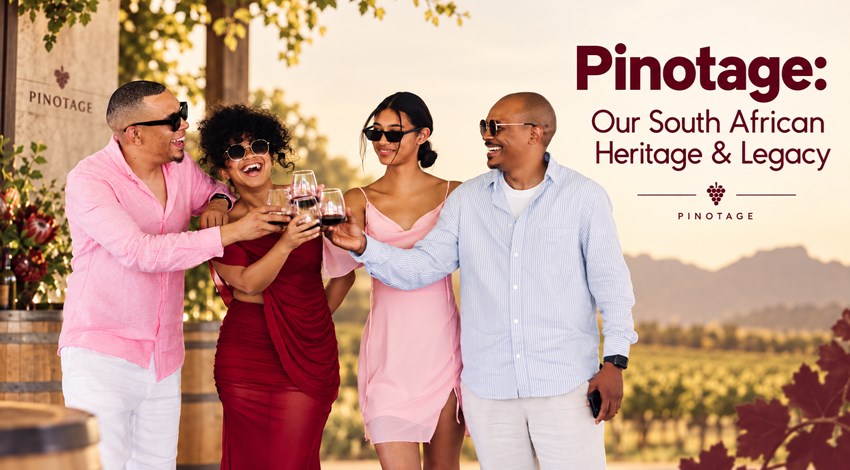
Born in South Africa, shaped by South African vineyards and argued over for much of its life, Pinotage has never had the comfort of being universally understood. It has had to earn its place. Perhaps that is precisely why it has become such an important part of our wine identity.
There is a golden thread running through its history: from vineyard to cellar, from one generation of winemakers to another, from the first serious benchmarks to the wines being made today.
The history of the Absa Top 10 Pinotage Competition gives us one way of following that thread.
The first competition was held in 1997. Thirty competitions later, exactly 300 wines have earned Top 10 status.
That number is not important simply because it is neat. Behind it are 300 decisions about what South African Pinotage could be at a particular moment in time.
Put the wines from 1997 next to those from 2026 and you are not looking at the same industry.
Vineyards have changed. Winemaking has changed. Oak regimes have changed. Alcohol levels, extraction, picking decisions and ideas about ripeness have all been debated and reconsidered.
What has remained is the variety.
That is where legacy becomes more interesting than nostalgia.
A legacy does not require each generation to copy the one before it. Quite the opposite. Its value lies in giving the next generation something substantial enough to question.
The producers at the top of the historical Top 10 record show what sustained commitment looks like.
Kanonkop leads the archive with 17 Top 10 wines. Beyerskloof follows with 16, Rijk’s with 14 and Diemersdal with 13. Flagstone, L’Avenir and Windmeul have each reached ten.
Together, those seven producer names account for 90 of the 300 Top 10 places awarded since 1997.
That is 30 per cent of the entire record.
There is consistency in those numbers, but there is no guarantee.
A producer’s history cannot enter a wine on its behalf.
Every new vintage has to stand on its own.
Perhaps the best example is Beyerskloof. Its 2026 result extends an extraordinary run to nine consecutive winning competitions, from 2018 to 2026.
Nine years of Top 10 recognition says something about continuity, but it also speaks to adaptation. No vineyard gives exactly the same fruit every year. No season repeats itself. Consistency in wine is not repetition; it is the ability to respond without losing your sense of identity.
At the same time, Pinotage history has never belonged only to established names.
That matters.
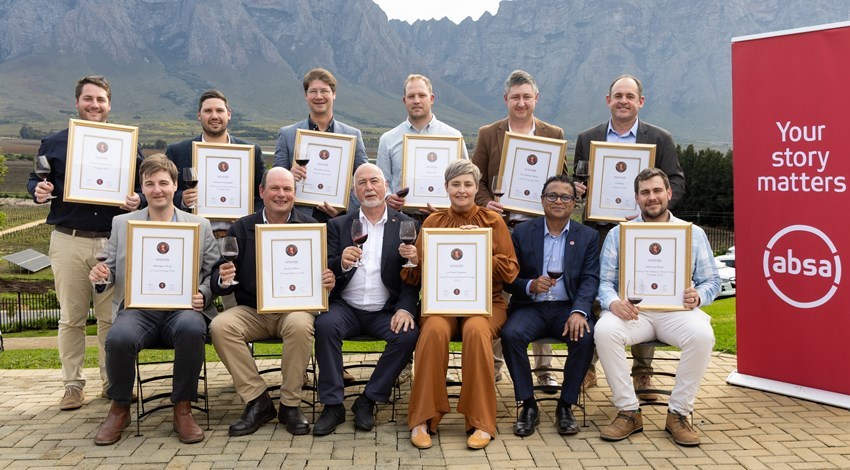
Absa Top 10 winners:
Back ltr: Richard Schroeder, Handré Visagie, Anri Truter, Juandre Bruwer, Tiaan Loubser, Stephen Joubert.
Front ltr: Daniel Slabber, Bussel Rietief, Beyers Truter (Chairman), Debbie Thompson, Anand Naidoo (Absa), Herman Du Preez
In the 2026 competition, three producer identities entered the historical winner record for the first time: Du Toitskloof Wines, Langdam FrostLine and Groot Phesantekraal.
Le Grand Domaine offers another telling example. It entered the Top 10 record for the first time in 2025 and returned immediately in 2026.
That is the other side of inheritance: the door must remain open.
If heritage belongs only to those already inside the room, it eventually becomes irrelevant.
The geographical story has opened up too.
The early Top 10 results were heavily centred on Stellenbosch. Stellenbosch remains central to the history of Pinotage and continues to produce a significant share of the winning wines.
But the modern map is larger.
The 2026 Top 10 alone includes wines from Stellenbosch, Durbanville, Swartland, Malmesbury, Wellington and the Koo Plateau.
That last name deserves attention.
Koo Plateau would hardly have featured in most conversations about leading Pinotage regions three decades ago. Today, a wine from there sits alongside established names in the Top 10.
This is what makes the Pinotage story worth following.
The variety carries a South African identity, but it refuses to belong to only one place or one style.
It can speak through warmer sites and cooler ones. Through old vineyards and younger plantings. Through wines intended for earlier drinking and wines built for time.
The competition record also shows something else: success in Pinotage is rarely accidental.
Of the 300 Top 10 places awarded, 255 - 85 per cent - belong to producer identities that have won more than once.
That is an unusually strong measure of repeat performance.
Yet in the same archive are dozens of first-time winners.
Both are necessary.
The old names provide memory.
The new names provide movement.
And between them runs the thread.
Pinotage is our heritage not simply because it was created here, nor because South Africa can claim ownership of its origin.
It is our heritage because generations of South Africans have continued to work on it.
They planted it when others dismissed it.
They made mistakes with it.
They learned.
They replanted.
They changed techniques.
They challenged one another.
They passed vineyards and knowledge from one generation to the next.
And they kept putting the wine back into the glass to be judged again.
That is also why Pinotage is our legacy.
The word “legacy” is often used to describe what has already been achieved.
In wine, it should mean something more demanding.
It is what we leave the next person to work with.
After 30 competitions and 300 Top 10 wines, the Pinotage story is not complete.
It should not be.
The most respectful thing we can do with a South African inheritance is not to freeze it in time.
It is to make the next bottle worthy of the bottles that came before it – and different enough to show that we are still moving forward.
Congratulations to the 2026 Absa Top 10 winners:
|
Producer
|
Vintage
|
Wine
|
Wine of Origin
|
|
Diemersdal
|
2024
|
Diemersdal The Journal Pinotage
|
Durbanville
|
|
Survivor Wines
|
2023
|
Survivor Pinotage Reserve
|
Swartland
|
|
Beyerskloof Wines
|
2022
|
Beyerskloof Diesel Pinotage
|
Stellenbosch
|
|
Du Toitskloof Wines
|
2025
|
Du Toitskloof Granite Pinotage
|
Malmesbury
|
|
Koelenhof Wynkelder
|
2023
|
Koelenbosch Director's Reserve Pinotage
|
Stellenbosch
|
|
Wellington Wines
|
2024
|
Wellington Wines La Cave Pinotage
|
Wellington
|
|
Stellenrust Wines
|
2024
|
Stellenrust ArtiSons The Professor's Perfect Crime Pinotage
|
Stellenbosch
|
|
Langdam FrostLine
|
2024
|
Frostline Pinotage
|
Koo Plateau
|
|
Groot Phesantekraal
|
2024
|
Groot Phesantekraal Pinotage
|
Durbanville
|
|
Le Grand Domaine
|
2024
|
Le Grand Domaine Grand Vin de Stellenbosch Pinotage
|
Stellenbosch
|
For more information, contact brand@pinotage.co.za, visit pinotage.co.za for more info on the winners.