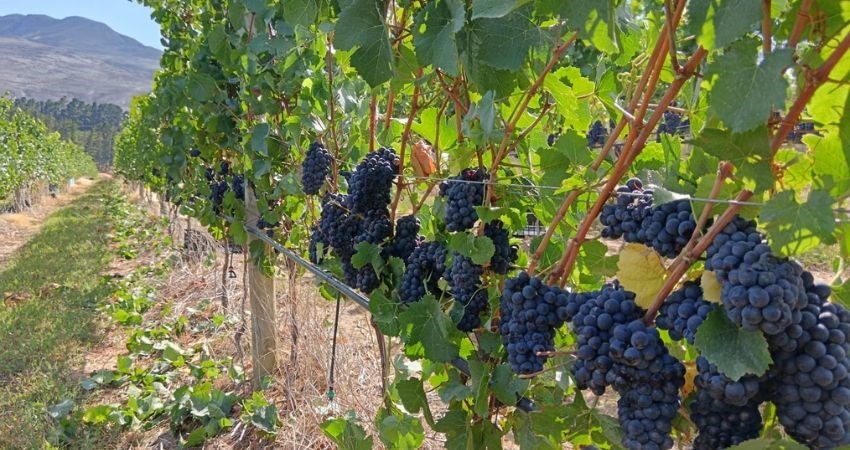
There are grapes you grow, grapes you make wine from, and then there is Pinot Noir. Despite having a notoriously thin skin, Pinot Noir gets under the thickest skin of any winemaker venturing towards its vinification. It can turn a perfectly rational winemaker into a man who spends a professional lifetime trying to understand why one patch of earth produces a wine that tastes different from another patch only a few metres away.
Andries Burger understands this. Perhaps too well.
Burger joined Paul Clüver Family Wine Estate as the estate established its own cellar, taking responsibility for the first estate vintage in 1997, without any particular plan to devote his life to Pinot Noir. The variety was known to him, of course, but in those days it occupied something of a peripheral position in the South African wine industry. “Starting out at Paul Clüver I had not been exposed to Pinot Noir,” he says. “As a student and young winemaker the variety was obviously on my radar, something you’d heard about and tasted, but had no plans to immerse yourself in.”
There was not much Pinot Noir to immerse oneself in anyway. In the 1990s the Cape's offering was limited, with relatively few winemakers prepared to take on what Burger describes as the challenge of vinifying “this regal grape of Burgundy”. More importantly, there was still a shortage of suitable vineyard sites. For Pinot Noir, site is everything.
Then came the visit to Burgundy.
After his first harvest at Paul Clüver in 1997, Burger was sent to Domaine Comte Senard in Aloxe-Corton. It was more than a winemaking internship. It was, by his own admission, an education in how to think about wine.
“I can’t truly begin to describe the influence this experience had on me as a winemaker,” he says. “Working with grapes and making wine in Burgundy is not about learning a process or getting to grips with the so-called ‘tricks of the trade’. In that region it is about allowing for a new state of mind in your relationship with and outlook on wine.”
That state of mind was about place. In Burgundy, the vineyards were not anonymous sources of grapes. They were personalities. Burger remembers living with a Burgundian family whose obsession with their vineyards was expressed in the way every parcel was discussed almost as though it were a member of the family.
“Each vineyard – many situated in the revered Corton appellation of Grand Cru parcels – was spoken of as a family member,” he says. “What each vineyard’s soil profile was, the aspect, the specific traits the berries showed during ripening and when they arrived at the cellar for the process of being transformed into wine. Same variety – Pinot Noir – but each site delivering a different wine due to the particular origin of its vineyard.”
This was a revelation in the Cape of the late 1990s, where the conversation around vineyard site and single vineyards was only beginning to gain traction. Burger became involved in the South African Wine and Spirits Board work group investigating how individual vineyard parcels could be identified and registered.
It was not academic curiosity. He was looking at the vineyards at Paul Clüver and beginning to understand what they could become.
“If I was going to implement what I had experienced in Burgundy, then my work as winemaker would be an extension of the vineyard,” he says, “as expression of site lies at the heart of the Pinot noir ethos.”
The vineyards gave him confidence. Paul Clüver's Elgin property, with its cool climate, decomposed Bokkeveld shale and underlying clay, had the raw materials. “Pinot Noir is at home on the Paul Clüver farm here in Elgin – I think we have shown this by now,” says Burger.
That conviction also required narrowing the estate’s focus. Paul Clüver once produced a broader range of red varieties, but over time the experience of farming De Rust led to an increasingly deliberate decision: if there was one red variety that truly belonged here, it was Pinot noir. Today it is the estate’s sole red-variety focus. Over time, the farm gave us the answer: Pinot Noir was the red variety we should pursue.
The climate is particularly important. Elgin's cold nights and long, cool growing conditions allow Pinot Noir to retain acidity while developing flavour. “Acidity presents freshness, the backbone on which Pinot Noir’s multi-dimensional aromas and flavours latch onto,” Burger explains. “The balance between a good acid structure and the fruit’s expressive, pure flavour profile combines to reach that sweet-spot of elegance and refinement.”
And so the obsession grew. And 29 vintages later, Burger's approach to Pinot Noir remains remarkably free of dogma. This is perhaps one of the paradoxes of the variety: the more you learn about it, the less inclined you become to believe that there is a single way of making it.
“Once you focus on the unique features of the vineyard, one becomes more attached to what each different season brings to the cellar in the form of the ripened grapes,” he says. “There is thus no recipe for setting the grapes on their journey into wine.”
Wild fermentation may be used, but inoculation can come into play when the fermenting must needs assistance. Oak is adjusted according to the character of the wine, as is the length of maturation. “Pinot Noir is a journey, a continual voyage of discovery,” Burger says. “And the greatest reward is allowing one’s customers to discover the magical character of a wine like no other.”
This year that journey received a significant endorsement from one of South Africa’s most respected wine competitions.
At the 2026 Investec Trophy Wine Show, the Paul Clüver Estate Pinot noir 2024 won the Trophy for Best Pinot Noir. It was the first time in 15 years that a Pinot noir had won the accolade. The 25th Trophy Wine Show attracted 650 entries, and the competition is hardly an easy one in which to collect silverware.
For Burger, the significance went beyond another trophy for the estate.
“It is terrific to see Pinot Noir acknowledged at the Trophy Wine Show, a competition known for its high standards of judging,” he said. “And, of course, it is especially pleasing to have Paul Clüver Estate Pinot noir being the wine to break the ‘Pinot drought’ at this year’s Trophy Show.”
There is a certain symmetry to the achievement. The wine that ended the drought came from a place where Pinot Noir has been the subject of an unusually long and sustained commitment. The vineyards range from three to 34 years old and include Burgundian clones, planted between 280 and 400 metres above sea level on the estate's shale and clay soils.
The 2024 vintage also played its part. A warm, dry early summer accelerated ripening and brought an earlier harvest, while cool nights retained acidity and freshness and smaller berries brought concentration and structure. In the cellar, the fruit was carefully sorted and handled with a restrained approach, with fermentation and maturation decisions made to support rather than overshadow the character of the vineyards.
But Burgundian yeast and French oak are not the story. They are merely the tools.
The story is a winemaker who went to Burgundy nearly three decades ago and came home seeing his own vineyards differently. It is an estate that kept planting, learning, refining and resisting the temptation to treat Pinot Noir as a fashionable side project. And it is an Elgin vineyard that has, over time, made a convincing argument for itself.
“To shine at the Trophy Show with its panel of esteemed international and local judges, a wine must be world-class,” Burger says. “Thus, having the Paul Clüver Estate Pinot Noir judged to be at this level, underscores our wine quality and shows that the Cape truly has the potential of producing Pinot noir of a global standard.”
That is a considerable claim. But after 29 vintages, Burger has earned the right to make it.