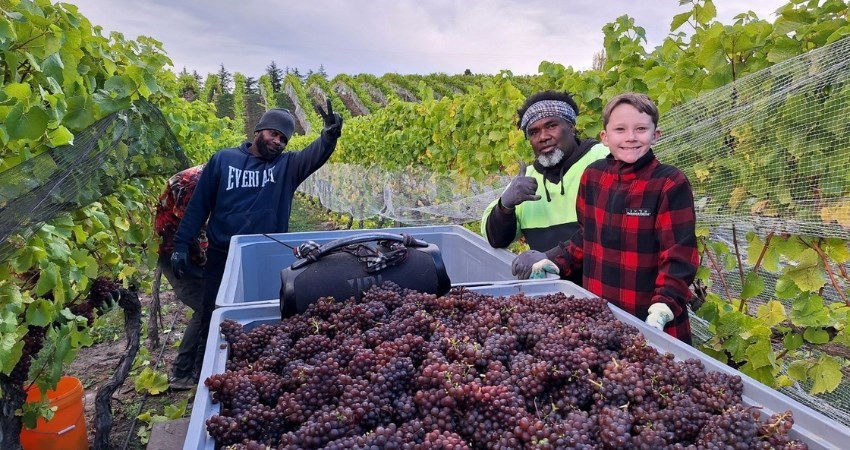
A 26-hour, 1,845-km journey by land and sea will take you from New Zealand’s northernmost vineyards, perched near the very tip of the country, to its southernmost in the Alexandra Basin of Central Otago. It’s a distance equivalent to travelling from Edinburgh to Marseilles, however the northern-hemisphere journey has the convenience of the Chunnel instead of an increasingly unreliable 3.5-hour antipodean ferry crossing.
It is this sheer geographical expanse that means most years, any national vintage narrative is a generalisation risking inaccuracy. The 2025–26 season was no different, with at times striking divergence between regions: Hawke’s Bay had its earliest harvest start on record with the Chardonnay harvest underway on 12 February; Marlborough logged its warmest spring in over four decades alongside its second-equal highest growing degree days (GDDs) at 1,492, while Central Otago endured one of its coolest and latest vintages in recent memory, with Gibbston only just creeping over the 800 GDD mark.
Yet, while there were pronounced regional differences, there were some strong unifying threads woven into this season, too.
A warm, largely frost-free spring from mid September into November set the stage, accelerating vine growth and supercharging phenological development. Then, just as most Kiwis were digging out the board shorts, jandals and barbeque tools from the back of the cupboard, a cool, unsettled summer entrenched itself. Above-average rainfall was recorded across all regions, heightening disease pressure. Yet just as nerves were fraying, the season turned. An outstanding warm, dry autumn from March into April emerged in most places, restoring order and allowing fruit to reach full potential.
It was, in many respects, a season that read like a novel – opening with momentum and anticipation, drifting into tension through an awkward middle, before resolving with a compelling and satisfying end.
That said, it was the extremities (both north and south) that seemed to face the greatest challenges.
In canvassing perspectives from winemakers and growers across the country, what stands out is not uniformity of experience, but unity of sentiment. Across the board there is a clear confidence in the quality of the 2026 wines. While next week we’ll have a firmer idea about production volumes from our national wine body upon the publication of the annual harvest survey, the consensus is that volumes will be less than average, particularly so in the shadow of the abundant 2025 harvest.
In the wider context, there is a growing acknowledgement that New Zealand wine finds itself in a period of recalibration. Despite our geographical isolation, we are deeply exposed to global market forces, with approximately 90% of our production exported and most of that is, unsurprisingly, Sauvignon Blanc. We are not immune from the pain the global wine industry is experiencing right now. There’s excess inventory, weak demand in certain channels, rising costs and uncertainty.
For some, there are now existential questions about viability as fruit remains unharvested, vineyards are mothballed or grubbed up and difficult decisions are being made. New Zealand’s bulk market has crashed, the drop in demand for grapes leading to bulk-wine price below the cost of production.
Conversely, the strong brands are seeing healthy growth in sales. The market is clarifying what matters and is sending a signal. While the New Zealand wine style of freshness, purity and elegance is what global consumers want, the market is also rewarding wines with identity – those that speak of place, that are underpinned by long-term intent and quality rather than short-term opportunism.
It is tempting to frame this as a correction. I personally hope it is better understood as maturation.
To read the full article, click HERE.