Rooted in the quiet truths of history, the name ‘Rixdollar’ carries the weight of an older world. The term – used in English to describe silver coinage that moved across the European continent – also found its place in the early economies of the Cape Colony and Ceylon. Yet its form was not the same everywhere. While the Rixdollar existed as a physical silver coin in Ceylon, at the Cape it lived more often in promise than in hand – recorded, exchanged and trusted, but rarely held as coin. Even today, the few unissued Rixdollar banknotes of the Cape of Good Hope remain as rare fragments of that time.
It is within this same historical current that our Old Vine Cinsault finds its voice. These vines, rooted deep in Western Cape soils, belong to an era shaped not by precision, but by perseverance – when value was understood through labour, land and legacy. Like the Rixdollar, they speak of endurance, of systems built in faith and of a past that continues to echo quietly through what we cultivate today.
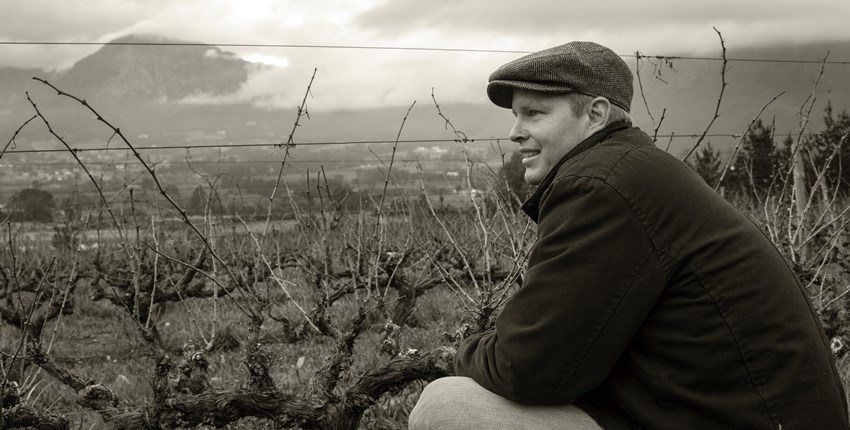
Planted in 1974, this one-hectare vineyard rests at the foothills of the Helderberg, its origins rooted in a different era. The soil was first turned not by machine, but by mule – a deliberate, patient beginning that still echoes through the vineyard today. Now recognised as one of Stellenbosch’s oldest sites, Rix Dollar stands as a living record of resilience and continuity.
Set on dryland soils of weathered granite, the vineyard demands attentiveness rather than intervention. Our work here has been guided by observation – restoring vitality through natural means: cover crops to nourish the soil, reopened ditches to guide water and straw laid beneath the vines to preserve precious moisture. In a site where late-ripening Cinsault can be vulnerable to the pressures of dry seasons, each action is measured, each decision considered.
This is a biological and regenerative system. Nguni cattle move gently through the vineyard, managing weeds and enriching the soil as they go. No chemical inputs have been used for the past two years; instead, life is returned to the vineyard through compost and natural fertilisation. The vines respond in kind – with broader leaves, renewed vigour and fruit that carries both energy and clarity.
A living fence of keiapple encircles the block, offering quiet protection while reinforcing the vineyard’s ecological balance. Every task is completed by hand, preserving not only the integrity of the vines but the intention behind them.
Beside the vineyard lies a fragment of history – a surviving section of the original road between Stellenbosch and Somerset West, built under the direction of Willem Adriaan van der Stel. It rests beneath old oak trees, a quiet companion to the vineyard, reminding us that this land has always been shaped by those who listen to it.
In the cellar, the same philosophy prevails: minimal intervention, careful guidance, and restraint. The vineyard is allowed to speak – through small, concentrated berries that yield a wine of subtle power. The result is a Cinsault of nuance and elegance, layered with quiet intensity and depth.
Production is extremely limited. Its significance, however, extends far beyond volume. This is not simply a wine, but a continuation. It's a living expression of heritage, patience and the enduring wisdom of old vines.
Click HERE to shop the Rix Dollar Cinsault now.