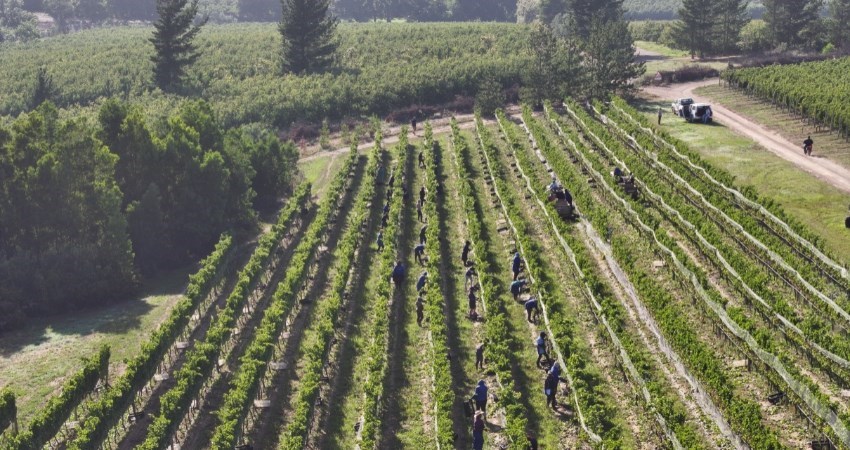
In Elgin, the 2026 vintage will be remembered as a season that demanded attentiveness and rewarded adaptability. Following a dry winter and spring, the growing season unfolded with momentum, shaped by warm conditions and punctuated by untimely rainfall that required careful decision-making in the vineyards.
At Paul Clüver Family Wines on the De Rust farm, cellarmaster Andries Burger – marking his 30th harvest with the estate – reflects on a year that called for both experience and agility. “It was a challenging season that kept us on our toes,” he says. “We had to stay close to the vineyards and respond thoughtfully as conditions evolved. They say wine is made in the vineyards, and to a certain extent this is true. But in this year’s harvest, the role of the winemaker and cellar teams was crucial.”
Rainfall across the farm varied, with precipitation levels between 442mm and 621mm. The early part of the season remained notably dry, particularly from September to December, before later rains required a more hands-on approach, especially in sensitive varieties like Riesling.
These conditions extended the harvest window significantly. “The harvest window extended to over 35 days this year, compared to 23 last year,” Burger notes. “It meant going into the vineyards more often and making precise picking decisions block by block.”
Despite the challenges, the growing season benefited from strong winter dormancy and favourable conditions during key stages. Budbreak, flowering, and fruit set were all very good, supported by moderate daytime temperatures and cool nights – hallmarks of Elgin’s climate.
Harvest began slightly earlier than usual and progressed with notable pace. “Normally the first week of harvest is a bit hesitant,” Burger says. “This year we processed nearly 100 tons in that first week alone.”
In the cellar, early indications point to a vintage of clarity and promise. Chardonnay, in particular, stands out. “It looks very promising,” says Burger. “We’ve brought in our largest Chardonnay crop to date, with excellent acidity and balance. The chemical analyses across the board looks exceptional.”
Pinot Noir, always a variety that reflects the nuances of the season, is showing encouraging signs of purity and aromatic lift. Careful vineyard selection and attentive sorting have laid the foundation for wines that express purity and finesse, true to the estate’s style.
Across all varieties, the defining theme of 2026 is precision: in timing, in decision-making, and in execution.
While the season presented its share of challenges, the outlook remains decidedly positive. “All in all, the analysis of the fermented and just-fermented wines looks exceptional, and we’re optimistic about the vintage,” Burger concludes.
For now, as Burger suggests, the final word lies in patience: “Let’s see how it develops,” he says. “Harvest is a critical stage in the wine cycle and I know everyone is eager to ascertain the features of harvest 2026. But this will only truly be known once the wines have embarked further on their journey towards bottle, a journey which is every year one of joyous discovery.”