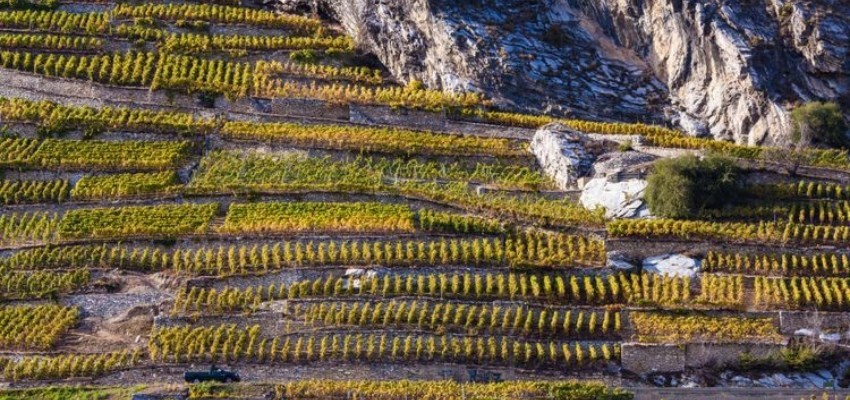
Microclimate may be one of the most misunderstood terms in the wine lexicon. Even its definition in The Oxford Companion to Wine, by Jancis Robinson and Julia Harding, begins with a misnomer: “Common use of the term ‘microclimate’ to describe the climate of a vineyard site, hillside, or valley is clearly wrong.”
In fact, those larger scales fall under mesoclimate. A microclimate refers to something much smaller, a precise pocket within a vine’s canopy, measured in millimeters to, at most, a few meters.
What microclimates are, and what they’re not
If your head is spinning, you’re not alone. This is a deceptively complex concept, one often blurred in both conversation and marketing.
“Microclimate is colloquially used for mesoclimate,” says Chris Miller, a Master Sommelier who’s been the winemaker at Seabold Cellars in Monterey since 2014. “People don’t know what ‘meso’ means, but they do know what ‘micro’ means: tiny. And ‘tiny’ starts to imply boutique or higher quality, so it gets thrown around.”
To make sense of it, it helps to zoom out. Macroclimate describes the broadest regional conditions, like an entire county or American Viticultural Area (AVA), such as Monterey or Chalone.
Mesoclimate narrows to a specific site, such as a single vineyard. In Miller’s case, that’s Olson Vineyard, where he sources Chardonnay. However, some vineyards are large enough to contain multiple mesoclimates.
Microclimates operate at the most granular level. “Mesoclimate is what a site is broadly capable of — an average of that site,” says Miller. “Microclimate is what actually determines how the fruit ripens.” That means airflow, humidity, sunlight exposure, canopy structure, and vine density — factors that are highly specific.
For most wine lovers, such detail may feel academic. But for vineyard managers and winemakers, it’s everything.
The importance of microclimates
A big reason microclimates matter is the balance in a finished wine. Most grapes are harvested within a range of about 20° to 26°Brix, which is a measure of sugar concentration. Many winemakers aim for something around 23°Brix. But within a single block, some clusters might register 19°Brix, while others climb to 27°Brix.
“It didn’t quite hit me until I started spending so much time in vineyards,” Miller says. “You start to notice one vine ripens quicker because there’s a 20-ton boulder in the way, and the wind doesn’t get around it. That vine doesn’t have wind stress and just bakes, getting to 26°Brix.”
One vine down, that same rock channels wind. It whips toward the vine to create stress, cooler conditions, and grapes that might only reach 22°Brix. That’s a microclimate that needs to be balanced in some way in the final wine.
Sometimes, those differences force practical decisions. Wind-exposed vines may yield less fruit, while sheltered ones risk overripening. Do you plant trees to break the wind, or does that create too much shade? These are the kinds of trade-offs vineyard managers weigh daily.
Microclimates also shape decisions around irrigation, especially whether a site can be dry-farmed. Here, climate and geology intersect. How much rain falls, and how well the soil retains it, can vary dramatically within a vineyard. Free-draining gravel behaves very differently from water-retentive clay. It influences not just vine health, but also which grape varieties will succeed in a given pocket.
Click HERE to read the full article.