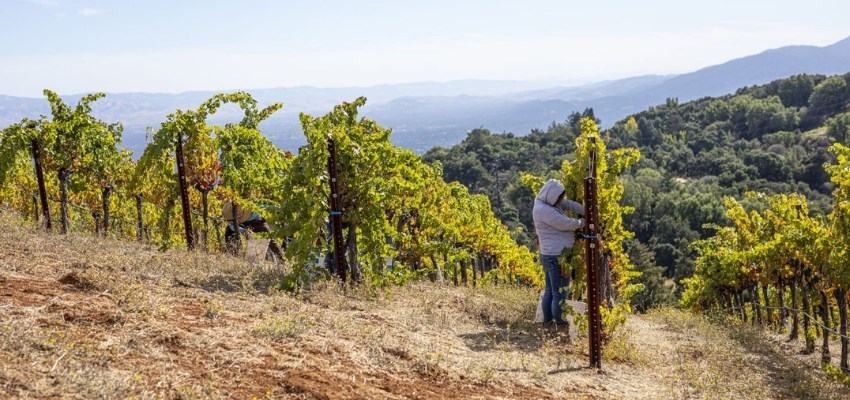
Vertical shoot positioning (VSP) is a trellis system (often interchangeably referred to as a vine training system) that can make for an attractive and efficient vineyard. Shoots—the greenery from which leaves, tendrils, and flower clusters, which eventually become grape clusters, grow—are pinned upward on movable catch wires as grape clusters develop.
When a canopy is “hedged on top religiously,” says Braiden Albrecht, the winemaker at Mayacamas Vineyards in Napa Valley, “VSP can appear clean and ornate, the vineyard like a garden.” Mechanical equipment thus moves easily through rows, and more rows of vines can fit within a vineyard.
In the 1991 book Sunlight Into Wine: A Handbook for Wine Grape Canopy Management, authors Richard Smart and Mike Robinson classify VSP as one of the most popular trellis systems for commercial vineyards, noting, “because the shoots are uniformly trained, all the fruit is in one zone, and the shoot tips are in another. This makes mechanical operations easy, like leaf removal, bunch zone spraying, and trimming.”
“A grapevine wants to crawl and climb and ripen bunches of tiny clusters for birds to eat so they can spread their seeds and make more grapevines,” explains David Gates, the senior vice president of vineyard operations at Ridge Vineyards. “We contain it to fit a system we can farm and sustainably work. If you want more vines per hectare or acre, and to be able to farm with a tractor and vehicle, then you are almost forced to use VSP.”
However, despite its efficiency and subsequent broad application, there are caveats; VSP does not meet the needs of every grape variety or growing site.
VSP demands “more intensive and thoughtful management efforts than required for most other trellis systems,” writes Stan Grant, a California-based viticultural consultant; this can necessitate greater expense. Justine Vanden Heuvel, a professor in the department of horticulture at Cornell’s College of Agriculture and Life Sciences and her colleague Andrew Robinson concluded in this 2009 study that a variety of training systems beyond VSP are “capable of improving wine quality through a combination of enhanced canopy and fruit microclimate.”
“The short story is that VSP isn’t always the best choice,” explains Vanden Heuvel. Here, SevenFifty Daily investigates VSP’s predominance as a vine training system, discerning where it works well, where it does not, and why.
Understanding vertical shoot positioning
“There really isn’t a true origin story for VSP,” explains Michelle Moyer, a professor of viticulture at Washington State University’s Prosser Research and Extension Center. “Grapevines like to grow on a structure, and we’ve developed different structures over millennia. The concept of training shoots vertically into a single plane or flat wall is common across multiple trellising systems.”
Its ubiquity means that VSP is often alternately referred to as a “vine training system” and a “trellis system,” the latter being “the permanent physical framework, like posts, wire, and fittings, that the vines grow on,” explains Justin Scheiner, Ph.D., an associate professor in the department of horticultural sciences at Texas A&M University.
“Vertical shoot positioning references how the canopy is trained,” says Moyer. “But to support that specific canopy training system, a trellising system was developed.”
Further, vine training systems vary in nomenclature based on how they are pruned in winter, which includes the practice of removing dormant wood to scale the plant to accommodate a select number of buds during the growing season. Therefore, systems that use a VSP structure may have different names because of the way they are trained and pruned; Scott Henry and Pendelbogen, for example, are variations of VSP.
To read the full article, click HERE.