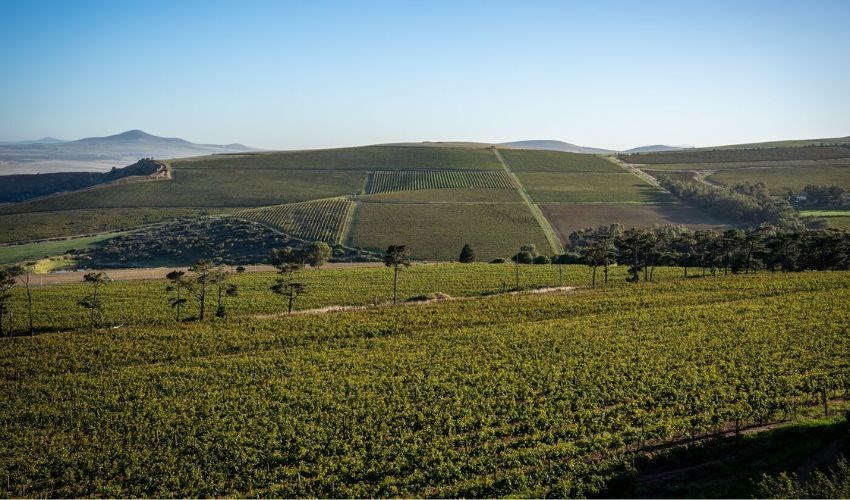
Although winter and spring rainfall ended earlier than usual, the Durbanville Hills vineyards entered the growing season in very good condition. Healthy vine growth, low disease pressure, and well-managed canopies created a strong foundation for the months ahead. While persistent winds during October and November affected bunch set in some blocks, overall yields remained good and consistent across our producers.
December and January brought warm, dry conditions that played a defining role in shaping the harvest. These conditions encouraged steady, even ripening, with grapes reaching phenolic maturity at slightly lower sugar levels. Cooling sea breezes from the cold Atlantic Ocean helped to moderate daytime temperatures, mitigating heat stress during critical ripening stages. This allowed us to focus on balance, freshness, and flavour development rather than simply chasing sugar.
Water availability, often one of the biggest challenges in recent seasons, showed meaningful improvement. The water scheme performed better than in previous years, supplying improved quality and quantity during the crucial ripening period. This ensured irrigation could be applied when vines needed it most, contributing to consistent grape quality across vineyards.
Harvest officially began on 19 January with grapes destined for Cap Classique, followed shortly by Sauvignon Blanc and Chardonnay. From the very first deliveries, grape quality was highly promising, showing clean fruit, good natural acidity, and excellent flavour concentration.
Several new initiatives were introduced to improve both harvesting and grape reception. Alongside hand-harvesting teams, two new grape-harvesting machines were brought in to assist during peak periods. This allowed harvesting to start as early as 02h00 in the morning, particularly for Sauvignon Blanc, ensuring grapes were picked during the coolest hours of the day. One producer even fitted tractors with floodlights, enabling teams to start earlier and avoid the intense daytime heat.
At the cellar, the implementation of a new offloading system significantly improved intake efficiency, allowing grapes to be received faster and at cooler temperatures. This had an immediate and positive impact on wine quality. Early indications from the red varieties are especially exciting, with Pinotage, Merlot, and Shiraz showing great colour, soft tannins, and an impressive mouthfeel.
The season did not come without extremes. The harvest period included several unusually hot days, with temperatures reaching as high as 42°C. Despite these challenges, careful planning, adaptability, and close collaboration between vineyard and cellar teams ensured that quality was never compromised.
The 2026 harvest stands as a powerful reminder that great wines are made through teamwork, attention to detail, and respect for the rhythm of nature – principles that continue to guide every vintage we produce.