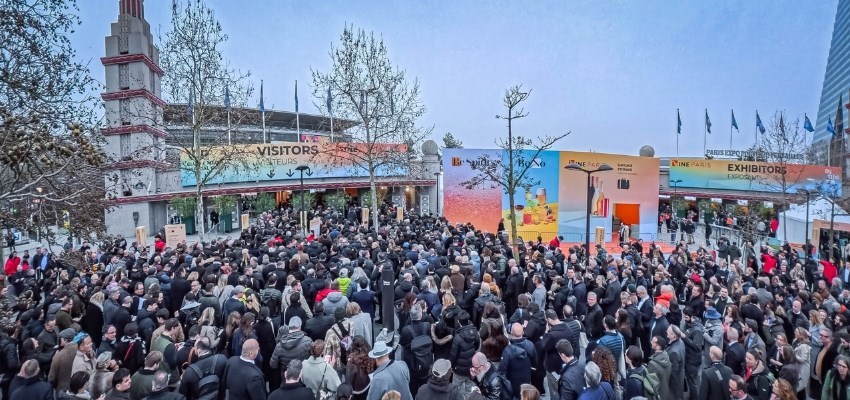
"There is a wine world out there looking for answers." Which is how Boutinot’s Mike Best MW succinctly summed up the mood at this month’s pivotal Wine Paris. It’s also probably why there was a record 63,541 people from right across the world of wine (and spirits) that travelled to the French capital no doubt in search for, and in the hope of finding at least some of the answers to the problems everyone in the global drinks industry is facing. Whether they found them or not is another question, but despite all the headwinds and trading difficulties, there was a real sense of purpose, ambition and momentum at the show. A realisation that this is an industry at a crossroads and the decisions we collectively, and individually, take now will determine who are going to be the winners and losers in the years ahead. But what was really being discussed by buyers and producers at the show? What challenges did they hope to solve? What opportunities did they hope to find? Richard Siddle in the first of a series of reports from Wine Paris was there to find out.
Not many people saw him, or heard what he had to say, but the fact President Macron actually came to Wine Paris was a vote of confidence not just in the significance of the show, but a shot in the arm for an industry in need of some tender, loving care.
A sector, like so many others, that has been rocked, bullied, buffeted and impacted by the fall out from the Trump-driven geo-politics and trading and tariff wars that Macron and his fellow world leaders have inflicted on us all.
He came offering no “silver bullets” but instead talk of how we “can generate value” by first “safeguarding” and “defending” an industry – at least in France with its €130m production relief programme – rather than “pushing” it “into a dead end”.
It was hardly Martin Luther King, but he left the industry with a rallying cry that became very much the theme of the show: “I prefer to look ahead.”
Which is exactly what all the wine and spirits producers, buyers, importers and merchants that came through the doors of Wine Paris were there to do. They came with no intention of picking over the carcass of increased costs, tariffs and supply chain woes, higher duties and the fact millions of people are drinking less alcohol around the world.
That is simply the context we all now have to live with and trade in. The opportunities to grow, make money and drive revenues lie not in what has come before, but what we can do differently and more effectively in the future.
The overriding positive mood at Wine Paris even took the departing head of the show, Rodolphe Lameyse, chief executive of Vinexposium – who is moving to a new role heading up food and drink for Comexposium, Vinexposium’s owners – by surprise.
“The optimistic and not pessimistic mood is the opposite to what I was expecting considering the global context,” he said.
For Wine Paris came at a time when the global wine and spirits industry is faced with falling demand and consumption across all its key markets, which has resulted in a growing backlog of inventory and unsold stock in the supply chain and wine sitting in tanks waiting to be sold – the US alone is said to have $22 billion tied up in its three tier system.
All of which has dried up cashflow at just the time when producers, importers and retailers need it the most.
But as hard as these headwinds are, Wine Paris proved the industry’s most forward-thinking players are ready to re-position – or recalibrate themselves – for a very different world they now operate in.
With 51% of the event’s exhibitors now from outside France it also proved itself as a true international show. Which came at just the right time for producers looking for new serious business to replace that being lost in their traditional markets.
Particularly welcome were those buyers and importers coming from the so-called emerging markets across the Middle East, UAE, Africa, India, Asia and South America.
It meant deals and discussions were not just focused on the usual annual cycle of trading but instead on decisions that might dictate where business goes for the next three to four years.
Mitch Fowler, at Fero, the new drinks fintech working capital and supply chain platform, sets out succinctly the framework in which the drinks industry is now operating in: “Producers, merchants and investors alike are navigating a market shaped less by growth and more by structural recalibration and finding sustainable economics.”
It was the year when no and low drinks – particularly 0% wine – become a serious category in its own right. “We’ve reached the point of critical mass,” claimed Origin Wine's chief executive, Bernard Fontannaz.
Arguably the most exciting aspect of Wine Paris was the sheer diversity of drinks and types of beverages on show. In fact Wine Paris might do well to rebrand itself as Drinks Paris as this was the year when the proverbial pandora’s box of possibilities was thrown open to the world.
Solutions not problems
This was also the year that Wine Paris firmly cemented its position as the number one international trade show – with 63,541 visitors and 6,537 exhibitors giving it their stamp of approval. But whilst the mood might have been upbeat, the buyer and producer discussions taking place on individual stands were deadly serious.
After all this is a drinks industry in turmoil and it is the producers, importers and suppliers that can go to their customers with fresh ideas and more effective and efficient ways of working together that are going to be the short and long-term winners.
As Fero’s Fowler explained: “The wine industry has weathered structural change before. While the current headwinds are real and persistent, they are also forcing a long-overdue reassessment of how value is funded, stored and realised across the supply chain.”
Origin’s Fontannaz captured the mood of the show: “Yes, it is difficult, but I have never seen as much speed of change as there is now. It forces you to be different and you can’t be caught out. We have competitors who are still looking through the rear window. We are only looking through the windscreen.
“Wine Paris is a great example of that. It has brought a new energy. If you snooze you lose. There are new opportunities out there every day.”
He added: “Supermarkets need suppliers who come to them with solutions. That is how we all grow. We have to be able to change. But it is change for the better. A chance to embrace new things.”
Click HERE to read the full article.