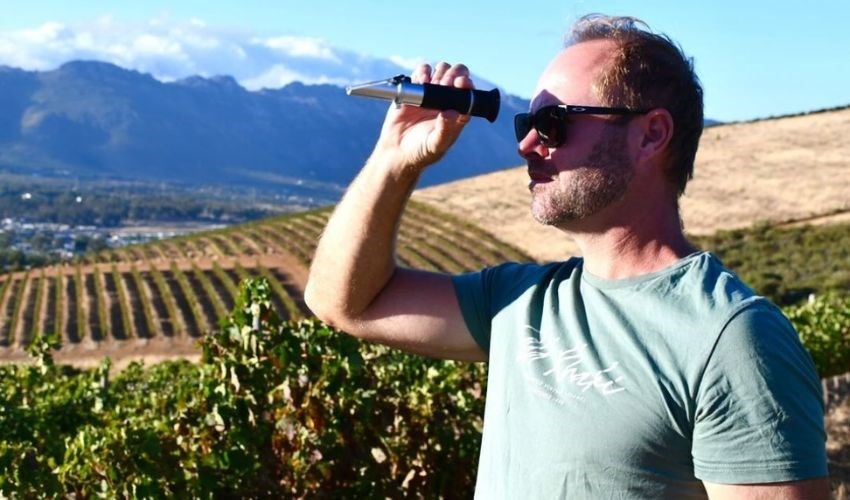
Henning Retief, Kleine Zalze viticulturist
He doesn't do it with fanfare. He does it block by block, slope by slope, and season by season.
There's a moment in every harvest when Henning knows. Not because a machine tells him, not because a number on a spreadsheet confirms it, but because the vineyard itself speaks. "We go," he says, leaning forward with the certainty of someone who has earned the right to say it, "when the grapes are calling."
That instinct has been two decades in the making. Henning joined Kleine Zalze Wines in Stellenbosch in 2006 and has been at the heart of every major chapter in its transformation ever since: from a hands-on family farm to an internationally recognised brand whose wines land on tables from Cape Town to Stockholm, a winery and brand now under ownership of French wine powerhouse Advini. Here Henning is not the loudest voice in the room, but he may be the most important one in the vineyard.
His connection to agriculture goes all the way back. Both parents grew up on farms, his family has roots in the Swartland sheep country, and he spent his school holidays driving tractors and helping with harvests. He grew up in Strand and Somerset West, surrounded by the rhythms of the wine industry almost by osmosis. "Agriculture and vineyards have always been part of me," he says simply, but with conviction.
After early stints at Annandale wine farm under the legendary Hempies du Toit, and time spent working in Robertson, Henning first set foot on Kleine Zalze in 1999 during a harvest. Parts of the farm had no roads. No houses. "I saw it when it was nothing," he laughs. By the time he returned to stay in 2006, things were moving, and they haven't stopped since.
Today, Henning oversees a sourcing network of approximately 60 producers, with around 90% of fruit drawn from Stellenbosch, supplemented by carefully chosen parcels from Durbanville, Darling, and Piekenierskloof. Managing a portfolio this size requires not just technical expertise, but something rarer: the ability to build genuine, lasting relationships with the people who grow the grapes. "You need trust," he says. "Open, honest, long-term relationships. I look for growers who are willing to adapt, to evolve, to try new approaches. I look for people who are in it for the wine game."
What he's not interested in, is generic. When Henning visits a vineyard, the question he carries with him is: What is the site giving us? Every slope, every aspect, every soil type tells a different story, and he's the kind of person who actually listens. He matches cultivar to site with the precision of a craftsman. Because, for him, planting the wrong grape in the wrong place is a conversation stopper before a single bottle is ever filled.
The physical rhythm of his year is relentless. Pruning runs from June through August. Spring brings a cascade of viticultural work to prepare the vines for the coming season. Then harvest arrives, and Henning is fully immersed, personally in the vineyard blocks, monitoring sugar levels and ripeness plot by plot, making the kind of granular decisions that only come from deep, embodied knowledge of a place. "You cannot replace experience and old core fundamentals," he says, "but technology can strengthen them."
He's no Luddite, this Henning. Kleine Zalze was among the first estates in Stellenbosch to adopt metal vine poles at scale, enabling easier mechanical harvesting and lower maintenance costs. Innovation, yes. But never at the expense of getting the basics absolutely right. "Doing the basics very well," he will tell you with quiet conviction, "is the key to success."
The 2026 harvest arrived approximately three weeks earlier than expected – Shiraz running two weeks ahead of the previous year. Henning had already been watching. He'd seen the signs coming and was ready to move. That readiness is everything.
Ask him what excites him in the vineyard right now and his eyes light up. He's personally drawn to Grenache, Cinsault, and Cabernet Sauvignon, and he enjoys a good Chenin Blanc with genuine pleasure. But the variety that truly animates him at the moment is Alvarinho, the elegant Portuguese white grape he's currently working with just one or two producers. "Scarce," he says, almost reverently. "Distinctive. Full of potential." Watch that space.”
After 20 years, Henning has grown not just alongside Kleine Zalze, but within it. Colleagues became close friends. The institutional knowledge he carries is the kind you simply cannot buy or shortcut. He stayed, he'll tell you, because of the people and the environment, and that says something powerful about a workplace, and about a man who values authenticity above almost everything else.
He operates without fanfare, largely behind the scenes. But when you taste a Kleine Zalze wine that sings – the fruit precise, the site character unmistakable – there's a good chance Henning Retief was in that vineyard long before the winemaker ever got involved, asking the right questions, listening carefully, and waiting for exactly the right moment to move.
Because the grapes were calling. And he was already there.