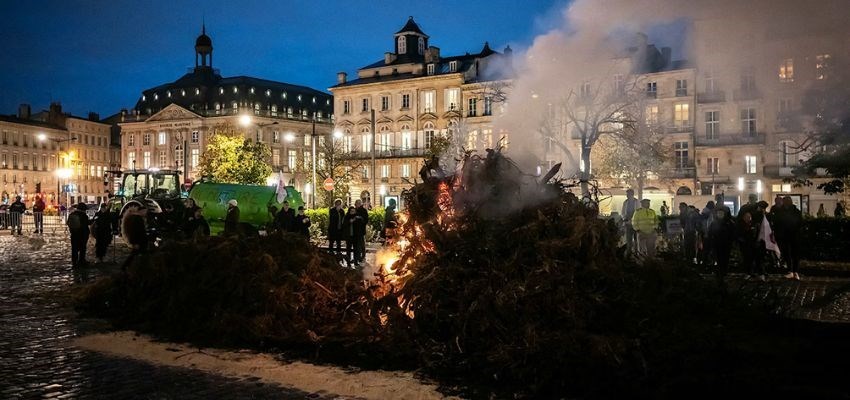
The scene at an auction house in Bordeaux’s Blaye region last November crystallized a crisis decades in the making: 800 hectoliters, or 90,000 cases, of organic Blaye wine, the inventory of a winery that had fallen into bankruptcy, was sold for just €25 per hectoliter, or about €0.23 per case. The normal low is €80.
That night, vigilantes responded by opening the spigots on tanks containing 110,000 cases for similar lots, letting the wine run into the gutters rather than see someone buy it and flood the market with cheap wine, dragging prices even lower.
"It's a crève-cœur, a heartbreak," said Jacques Chardat of Corlianges, a négociant distributing wines from 20 châteaus in Blaye and Bourg, which lie just across the Gironde river from the Médoc. "For a vigneron to see their property sold at auction is the end of a life's work, sometimes the result of several generations’ life’s work on the property."
Bordeaux’s wine industry is facing an existential crisis, and it’s not merely about money. Family legacies—vineyards that survived phylloxera, world wars and countless difficult vintages—are disappearing because the fundamental economics of Bordeaux wine have collapsed. While the top classified growths of Bordeaux get much of the attention—and are facing their own struggles, thanks to slumping sales and a futures system that appears broken—Bordeaux is France’s largest fine wine region, with thousands of vignerons farming more than 250,000 acres of vines.
But life is changing rapidly for those vignerons, thanks to a perfect storm of weakening exports and fundamental changes at home. What will it mean for one of the world’s most historic wine regions?
The numbers behind despair
Late last November, France’s Minister of Agriculture, Annie Genevard, announced a €130 million fund for a vine uprooting (arrachage définitif) plan spanning 2026 and 2027. The measure aims to rebalance supply with sharply declining demand, particularly for red wines.
It’s a dramatic shift, though one that should have been predicted. In 2015, Bordeaux produced 555 million cases of wine and sold 610 million. "Everybody was so happy, that in the strategic plan for 2018-2025, the CIVB and all the professionals were saying we need to plant more vines," said Jean-Pierre Durand, a négociant at AdVini and a board member representing Bordeaux merchants on the CIVB, the Conseil Interprofessionnel du Vin de Bordeaux, a powerful local trade group.
Click HERE to read the full article.