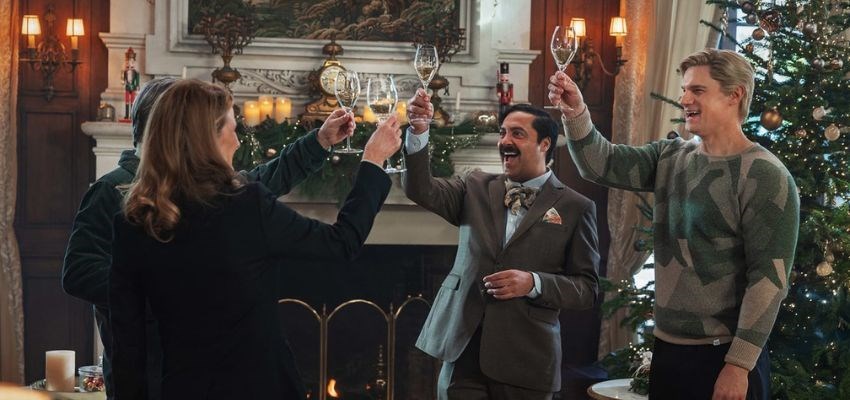
“Champagne isn’t just a drink, it’s a celebration,” begins the voiceover on the opening sequence, which goes on to describe what makes “a sparkling wine from a tiny region in France so special.” Aside from being an effervescent rom-com romp, the film gives surprising care to its subject matter and setting, underscoring some of the real challenges facing winemakers in Champagne and throughout France.
At a time when the wine industry needs help connecting to a wider audience, Champagne Problems – now the number one film on Netflix – is bubbly in all the right ways.
A real Champagne problem
Just as Champagne follows a specific procedure, so, too, do holiday romance movies of the Hallmark variety: an ambitious, overworked, urban-dwelling woman is deposited into a bucolic setting, where she proceeds to fall in love with a humble local.
In Champagne Problems, financial executive Sydney Price (played by Minka Kelly) ventures to Champagne to potentially buy a struggling legacy Champagne house, the fictional Château Cassell. She meets Henri Cassell (played by Tom Wozniczka, also of wine-themed Drops of God stardom), the wayward son of the brand’s owner Hugo Cassell, who doesn’t want to take over the family business, but doesn’t want to see it sold off to an entity that may sacrifice the quality and eschew tradition.
The premise here is actually realistic, which is more than we can say of most holiday rom-coms. “This is absolutely relatable,” says Brice Bezin, cellar master of Champagne Telmont. “Many historic Champagne houses are navigating a similar crossroads – how to honor a century of savoir-faire without compromising under short-term financial pressures.”
This trend isn’t necessarily new. Beginning in the 1980s, tax laws went into effect that made it more financially attractive for wine brands to acquire new corporate ownership rather than pass their assets on to the next generation. Staying in its holiday lane, the film doesn’t mire itself in the adversity, but Hugo and Henri are respectively wistful and guilt-ridden in turn about potentially selling the house to a third party.
“We deeply appreciate when Champagne is represented accurately in mainstream media,” says Lori Russo, the director of the Bureau de Champagne, USA. (She is especially pleased that the story emphasizes that Champagne can only come from Champagne, France.) “Many Americans recognize Champagne as a symbol of celebration and pleasure but may not be as familiar with the region’s history, its resilience, the families behind the wines, and the generations of savoir faire that make Champagne distinctive and singular among the world’s sparkling wines.”
Filmed entirely within the region (besides the Paris locations in the early part of the story), the film also shows Champagne and the city of Épernay to full advantage.
Click HERE to read the full article.