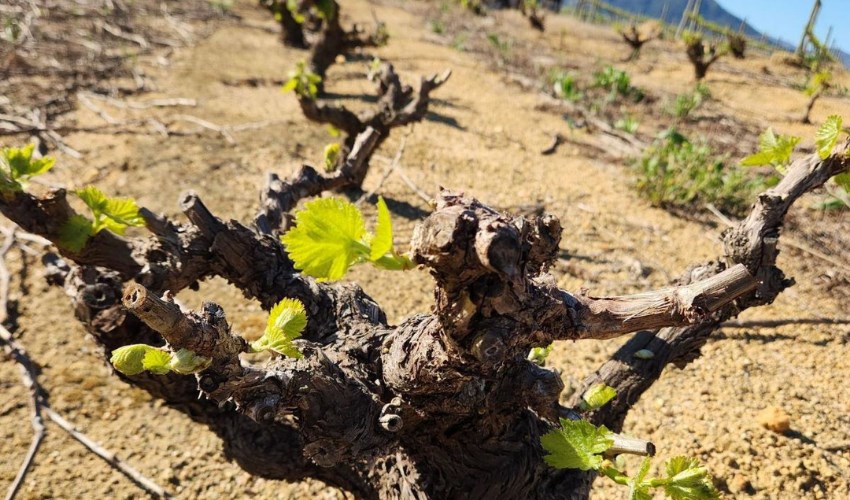
Painted Wolf Wines welcomes you to spring
Spring has eventually sprung in the western Cape, and with-it new life in our vineyards.
It has been one of the coolest and wettest winters for many years, and many areas of the Western Cape have been subjected to episodes of major flooding. Vineyards too have been flooded as dams failed and rivers burst their banks. We have watched in horror as friends have reported catastrophic damage.
But we have been blessed in that the abundance of rain has helped our unirrigated vineyards, and we have been spared from the flooding and destruction. I visited two of our vineyards to access the condition and see if there is any damage. What greeted me was verdant beautiful vineyards with vines pushing their new buds, and bright new green life oozing from each vine. It is really exciting and makes one think about beautiful healthy grapes, and the wine they will produce.
Kasteelsig in the Swartland, where we harvest Syrah and Mourvèdre, and some of the Pinotage for Guillermo has already had over 1100mm of rain already this year. There has never been more then 700mm a year in the 15 years we have bought grapes from Kasteelsig. The ground is saturated. This bodes well for the next few seasons. Topsoil here is very deep, and rich in red clay, and the roots snake down far into the earth. Budding is late here as saturated soils are cool.
Welgugund in Wellington has also had copious rain, more even than. The soil here is decomposed granite of a clay substrata and is much better drained. The Chenin block is in an old riverine area and holds water better. It all looks very promising here.
Lastly, I had a chat with Anton Roos, the manager at Silk Bush in Breedekloof, and this is what he has to say: “We are ok, not at as much rain as other places. We have had 940mm for the year, it is enough now! It must dry out. I think we can expect a smaller harvest, smaller bunches, and less berries per bunch because of the roots not getting warm enough to grow properly.”
So, overall we are looking at a smaller crop of small bunches (small, concentrated grapes) supported by plenty of leaves to encourage good ripening….hopefully an outstanding vintage.
Wine of the month: Painted Wolf Guillermo Pinotage 2020
October is Pinotage month, so don't miss this opportunity to get one of the most popular wines in our range whilst it's on promotion! ‘Guillermo’ is named after our good friend Billy ‘Guillermo’ Hughes. He is the owner and custodian of the Kasteelsig vineyard in the Swartland which provides the grapes for this wine, and has been certified Organic since 2012.
A beguiling wine with rich, spicy red berry and black cherry aromas, evident ripe tannins and a long, complex finish. 4.5* in Platter’s Wine Guide 2023 and winner of multiple other awards.
This wine drinks well in youth but will improve over time, gaining additional complexity for at least six to eight years from vintage. Guillermo is on promotion until the end of October so don’t miss out on our 20% off offer. Click here to order.
A weekend of wine and protection for the wild dogs of the Waterberg
Since the 1990s, researchers from the Endangered Wildlife Trust (EWT) have been monitoring reports of wild dogs roaming the Waterberg area of Limpopo province. Camera traps were installed and provided proof that a population of wild dogs was in the area despite busy roads and many other human pressures.
In 2019, Reilly Mooney, an American wildlife biologist had arrived in the Waterberg. It did not take long for her to become completely immersed in the challenges the dogs simultaneously faced and presented to landowners and conservationists alike.
In August 2020, the Waterberg Wild Dog Initiative (WWDI) was launched as a community focused project to work alongside the Endangered Wildlife Trust, bridge hostility by some landowners to the dogs, and to further the conservation of African wild dogs in the region.
One of the projects implemented by conservationists in the Waterberg is an ecotourism project that was developed by the EWT in 2018. The project has grown substantially in recent years to assist in mitigating human-wild dog conflict when the packs settle into a den site on private properties. The project seeks to offset the financial impacts to private properties during the denning season by bringing guests in to see the pack and generating financial support for the private properties where they are denning.
During the denning season, the pack is stationary around their den site to raise their pups and is reliant on the prey source in the immediate area to sustain them. In the Waterberg, that prey is privately-owned and has a financial value similar to livestock, creating the potential for conflict. The denning season is a critical time for the pack and their new pups, so it’s important for the pack to be protected during this time. The ecotourism project helps the pack pay for their own protection and is a win-win for the dogs and the community. Since the model was first developed, the ecotourism project has grown, as has the wild dog population, now numbering twenty-six individuals in two packs and two dispersal groups.
At the end of July, Painted Wolf Wines, in collaboration with the WWD and the EWT, hosted a special wine and wild dogs’ event at Lindani Lodges, which has been a great supporter of conservation in the area. Aside from the beauty of the location, the wine and tasty food and company, the highlight of the weekend was an excursion to a neighbouring property where the WWDI and EWT have been monitoring the “Melkrivier” pack around their den site. We could not approach the den, which could severely compromise the pup’s safety, but the team had staked out the situation and felt confident that their goal of collaring an adult could be achieved, with the PWW guests as privileged witnesses.
Like humans, they needed a little incentive to cooperate – and the carcass of a warthog was laid out a few hundred metres from the den and not too far from us. We waited, and waited, and waited some more.
And then suddenly were rewarded with the unmistakable silhouette of two pairs of “Mickey Mouse” ears among a dense thicket and a rapidly sinking sun. As all the adult members of the pack slowly arrived, and curiously and cautiously began to feed, a one year old female, who would be likely to disperse in the coming months and therefore provide important information on her movements, was darted and fitted with a satellite collar, and returned “back to life” to join the rest of the pack.
Our guests were ringside participants and more than elated – an absolute lifetime experience. Over a wine pairing dinner that night the wines could not have tasted better and our commitment to conservation clearer!