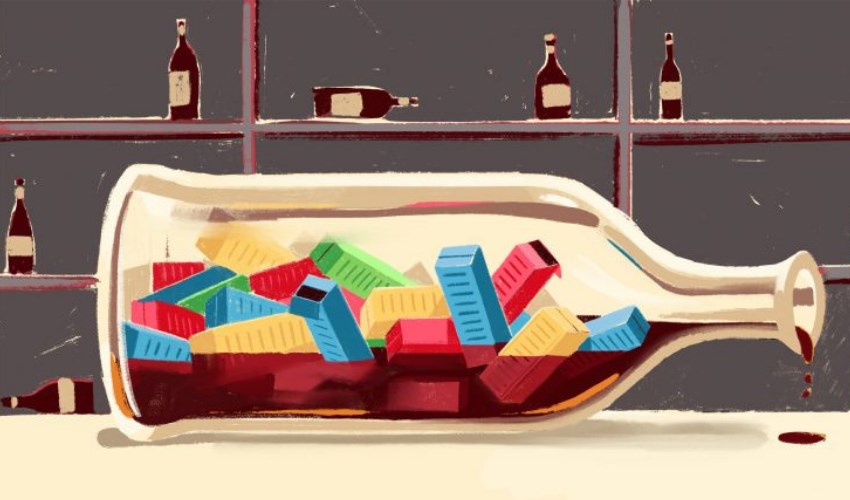
When Dan DeHart founded Grander Rum eight years ago, importing a Panamanian rum to the United States seemed like a perfectly sound idea. Today, the supply chain disruptions that have plagued the industry have created enormous challenges for his operation.
“When I have products sitting in Panama fully bottled, ready to leave the country, and I’m waiting for months to get it on a ship, it’s like pulling your hair out,” he says. “You can only imagine how many ships are passing through the Panama Canal. Surely they have space for one container I can throw on there to get up to New Jersey?”
DeHart’s frustration is shared by many in the beverage alcohol industry these days. Over a year since the disruptions began, things that everyone took for granted just a few years ago—importing a wine, shipping a spirit across the United States, finding warehouse storage, getting enough glass bottles—all remain enormous, and often very costly, challenges.
“I would say that in the past year I’ve had more situations put in front of me where I am honestly saying, ‘Wow, I’ve never seen this before,’” says Serena Campbell, the operations director of USA Wine West in Sausalito, California. “It’s like the rule book kind of just got tossed out the window. And we’re just having to figure out a lot of stuff as we go.”
Over a year into the crisis, and with no end in sight, the industry is mobilizing in different ways. Some are taking small steps in an attempt to douse immediate, day-to-day supply chain fires; others are introducing new services designed to mitigate supply chain impacts on their customers. And as they continue to copy, some industry members have begun to address fundamental flaws in the industry’s supply chain in the hopes of preventing such a shock to the system from ever occurring again.
Where things stand today
The big question at hand remains: when will these supply chain disruptions end? That forecast seems to be mixed, with some improvements reported, especially when it comes to out-of-stock items at the retail level. But most industry experts don’t expect things to return to any sense of normalcy until 2023 at the earliest.
“[I’m] sorry to report that there is no relief in sight,” says Alison Leavitt, the Portland, Maine-based managing director of the Wine and Spirits Shippers Association (WSSA). She says schedule disruption continues to be a major factor in virtually all areas, with port omissions, vessel bunching, and huge delays in transshipment ports continuing to cause significant delays. “Chaos is the new normal and we have adapted to reliable unreliability,” she adds.
Leavitt says it is hard to provide an average for today’s delays. Direct, port-to-port shipments that do not require transshipments (containers offloaded from one vessel onto another) can go perfectly, while other shipments get delayed by 30 to 90 days. “We have seen some shipments in transit for over 100 days on a route that used to average 24 to 26 days,” she says. “While there was a slight lull in the first couple weeks of January, vessels in almost all wine and spirits production areas are again at or over capacity.”
The disruptions are proving an enormous challenge for large distributors like Republic National Distributing Company (RNDC). “RNDC, our customers, and our suppliers, have all been impacted,” says Steve Feldman, the executive vice president, operations, for RNDC in Grand Prairie, Texas. Disruptions across the entire industry supply chain have created a snowball effect: Suppliers cannot get enough materials, causing product shortages for the distributor and its customers. At the same time, a shortage of trucks and drivers, poor rail service, and port congestion has resulted in delayed availability of the product that is made available from suppliers.
“This means delayed arrival of inventory and backorders to customers,” adds Feldman. “The labor crisis has exacerbated, and to a great extent contributed, to the supply chain crisis we are faced with.”
The same goes for industry service providers like the Manhasset, New York-based MHW. “The magnitude of the disruption really hasn’t changed much,” says Gabe Barkley, MHW’s CEO. “The cost of transportation is still as much as 300 percent higher than what we would consider ‘normal,’ while booking containers takes weeks of additional advanced planning. And warehouse space—especially on the East and West Coasts of the U.S.—is difficult to secure.”
While the disruptions have been taking a toll throughout the industry, smaller companies have been especially hard-hit. “You suddenly realize that the cost of shipping has tripled since early 2020,” says Nicolas Palazzi, the owner of PM Spirits in Brooklyn, New York, who has also been dealing with a laundry list of challenges, from demurrage costs (fees charged for containers that are not moved out of the port or terminal area within their allotted time frame), to lost product at warehouses. “It’s incredibly painful, it’s incredibly stressful, it’s incredibly costly.”
Difficulty obtaining a steady supply of glass bottles has been one of the largest strains on producers. For a while, the Rhode Island Spirits team, based in Pawtucket, Rhode Island, had a lack of bottles, forcing them to juggle whether to bottle their spirits immediately or store them in case an order for a more profitable item came in. In February, however, that problem then shifted to a case of “when it rains, it pours.”
“I’ve had standing orders for bottles, and now they’re all ready to be shipped now,” laughs Cathy Plourde, Rhode Island Spirits’ co-owner. “I don’t want to put off the order because God knows when I’ll run into this trouble again. And in the meantime, where the hell do I put all the bottles?”
Click HERE to read the full article.