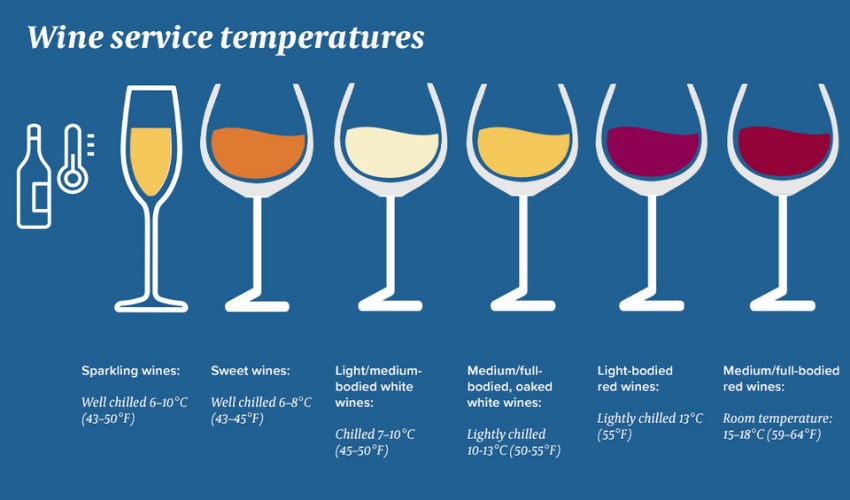
While the Oxford English Dictionary states that room temperature is conventionally taken as about 20 °C (68 °F), it might actually surprise you to discover that what's referred to as ‘room temperature for wines’ might leave you reaching for a sweatshirt, as it's actually, a bit cooler: 15 to 18 °C (59–64 °F).
What we've come to expect as normal room temperature for us is actually quite a bit warmer than the optimal serving temperature for wines. With the widespread use of air conditioning and central heating, rooms can often be either too hot or even sometimes too cold.
How to serve wine at the correct temperature
So why do we talk about service temperature? Generally speaking, wines show their best and the fullest expression of their styles and flavours when served at particular temperatures.
What temperature should you serve red wines?
Full-bodied red wines should be served at room temperature. If reds are too cold, they may taste thin and harsh.
Although you might be tempted to warm a red quickly, perhaps by placing it near a radiator, sudden exposure to extreme heat can permanently damage the wine. Instead, a good way to gently warm a wine is to hold the bowl of the glass in your hands.
If these wines are served at a temperature, exceeding 18°C, they can appear to lose their freshness and their flavour structure can become muddled. However, so long as they haven’t been heated too quickly, once they’ve cooled to the optimal service temperature, they should regain their balance.
What temperature should you serve sparkling, white and rosé wines?
As sparkling, white and rosé wines are best served chilled, ice buckets are commonly used in restaurants or bars to keep these wines cold at the table. However, there are some differences in the ideal temperature to serve white wines.
A full-bodied white, such as an oaked Chardonnay may only need to be lightly chilled (around 10-13°C), whereas light or medium-bodied whites, such as a Pinot Grigio will benefit from being served a little colder.
Just as wines can be served too warm, it should be noted that over-chilling, can mask the flavours...
Click HERE to read the full article.