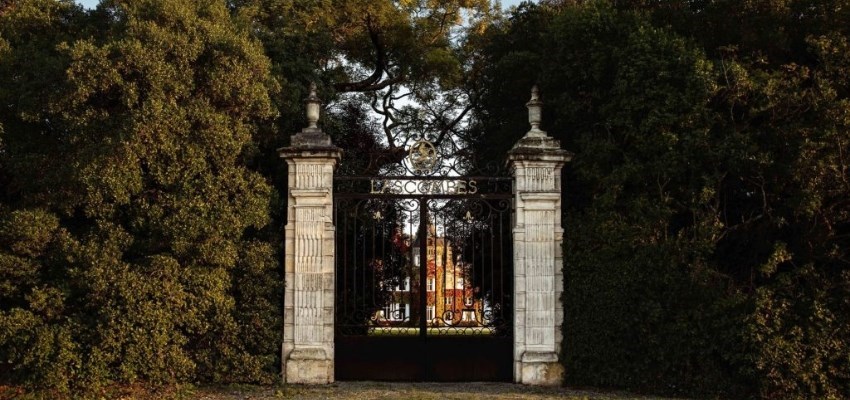
London is sweltering in the throes of an unprecedented June heatwave, the mercury surging rapidly into the mid- to high 30s celsius. Over in Bordeaux, the conditions are even more extreme, prompting Château Lascombes winemaker and CEO Axel Heinz to admit that this year makes the infamously torrid 2003 growing season look “almost normal”.
Heinz is in town with Chilean winemaker Sebastián Labbé, the man in charge of Casa Real, Santa Rita’s icon single-varietal Cabernet Sauvignon, to discuss how a changing climate – and also, perhaps, an evolving fine wine market – is affecting one of the world’s most famous and beloved grape varieties. Spoiler alert: they think it’s going to be ok.
Beyond Cabernet Sauvignon, you might think that the Alto Maipo and Margaux have little in common (and, historically, Lascombes has arguably been as famous for Merlot as for Cab; we’ll get to that later). But there are connections.
From Casa Real’s first vintage in 1989, says Labbé, it had a notable French influence, its 20 hectares of Alto Jahuel vineyard centred on the Carneros Viejo and Población parcels, sitting at an altitude of 565m and benefitting from the cool air wafting down from the nearby Andes. In a country where conditions often create rich, powerful wines, “this particular place is able to produce delicacy, with structure and a lot of freshness”, he explains.
Then there is Casa Real’s use of press wine – a technique more commonly associated with Europe than South America. This, says Labbé, is “very important to build the solid core of the wine” and, since he has pulled back on extraction in the winery, its quality has improved. In a fiercely hot and dry year like 2020, when the wine has a savoury, saline profile, Labbé believes that “the magic of the press wine helps to build structure and the viscous character”.
The other obvious common factor is the need to adapt to a changing climate. Heinz poses a question that verges on the existential: “Are the wines we’re going to produce in the near future and tomorrow wines that are still going to be recognisable as being from Bordeaux?”
The notion of “recognisable as being from Bordeaux” has always been a bit of a movable feast. Heinz harks back to the days when the region had more Malbec than Merlot, and more white wines than red. “We all like the idea of typicity being fixed, but it isn’t so,” he says. “Bordeaux in the 2020s is not Bordeaux in the 1980s, and it never will be.”
Click HERE to read the full article.