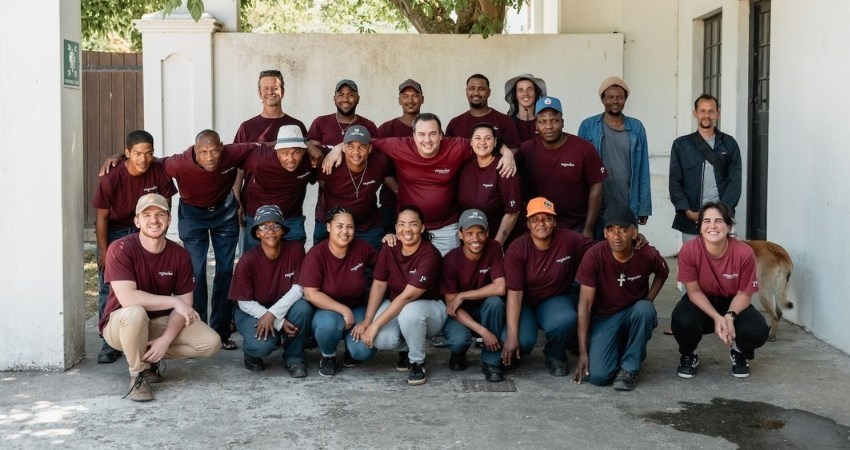
Johan Reyneke has spent two decades proving that winemaking can be a force for social change in South Africa. Now, with a reimagined Cornerstone range, and with a radical new value chain model developed with University of Cape Town and Harvard, he's looking to push this vision even further and challenge structural poverty. Sophie Thorpe sat down with the philosopher-turned-winemaker to find out more.
It’s easy to nod along with the concept of South Africa being a poor country – but putting the concept into cold, hard numbers drives the reality home. The country has among the highest level of income inequality in the world.
Measured by the Gini coefficient, the World Bank puts South Africa at 54.1% (2022, fifth worldwide), while the United Nations University World Institute for Development Economics Research (UNU-WIDER) puts it at 66.99% (2017, taking first place). For reference, the UK’s equivalent figures are 32.4% (2021, World Bank) and 34.24% (2022, UNU-WIDER). Unemployment is over 30%. A recent report by the South African government found that over 37.9% of the population live below the lower-bound poverty line. That equates to roughly 23.2 million people living in poverty – 93.6% of whom are black. There are 10.8 million people living in extreme food poverty. The average income of white households is almost five times higher than that of black African households.
Those aren’t numbers that invite change. But Johan Reyneke isn’t someone happy to accept the status quo.
Sustainability's human dimension
Reyneke grew up in Pretoria, moving to Cape Town aged 10. He studied law at the University of Stellenbosch, then pursued a master’s in philosophy, focusing on environmental ethics, in particular. A hippy with dreads, turned away from corporate jobs, he ended up working as a farm labourer, something that was far from common for a white man in South Africa. One day he and his colleagues were out pruning, and it was bitingly cold. He went home and put on his wetsuit under his clothes; those he was working with didn’t have such a luxury and resorted to newspaper. It was a pivotal moment – one he points to now as the inspiration for his Cornerstone project.
In the late 1990s, Reyneke took over a handful of vineyards (including one owned by his parents – a small parcel that came with the house they bought) and started his farming business. He soon realised he couldn’t make enough money selling grapes, so, he decided to make wine himself – turning the cowshed into a winery. Gradually, he built the farm up to 40 hectares.
The farm sits in the Polkadraai Hills, one of Stellenbosch’s eight wards. To the west of the town of Stellenbosch, with distinctive, decomposed granite soils, this is a cooler side of Stellenbosch producing notably elegant wines. Reyneke Wines' vineyards reach up to 300 metres above sea level, all south-facing towards False Bay, benefiting from cool sea breezes.
Click HERE to read the full article.