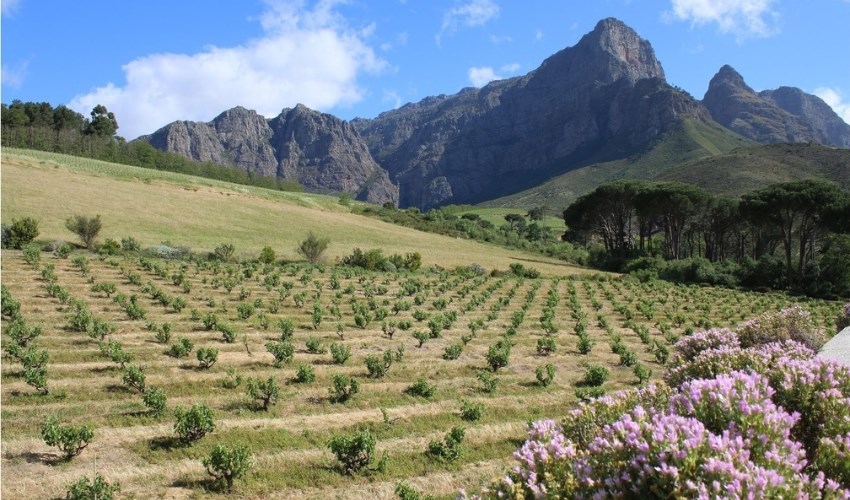
The historic Ou Bosstok Chenin Blanc vineyard on L'Ormarins estate in Franschhoek. First planted in 1964 on the slopes of the Paardeberg Mountains, L'Ormarins successfully transplanted these old bush vines in 2007-2008 in an unprecedented move.
Instead, you are greeted by thick, twisting, gnarled trunks that look more like weathered sculptures than agricultural plants. Some are head-trained bush vines, bowing low to the earth; others stretch upward, scarred by decades of winter pruning.
In an industry often obsessed with the flashy and the new, the global wine community is looking backward to secure its future.
But nowhere is this trend proving to be more of a lasting movement than in South Africa. Led locally by the pioneering work of the Old Vine Project (OVP), old vines have transitioned from romantic anomalies into some of the most sought-after agricultural assets in the world.
But beyond the romance and the poetry of 'liquid history', why do old vines matter?
Rosa Kruger, viticulturist and founder of the OVP, explains: "There is a running debate between pure science and winemaking intuition regarding old vines. Viticultural scientists point out that a vine does not magically alter its chemical makeup just because it turns 35. Yet, any winemaker who has stood over a sorting table will tell you that the fruit from old blocks possesses an irreplaceable depth, structure, and sophisticated texturing."
The secret lies in the vine's physical evolution over time. Young vines (under 10-12 years) are notoriously energetic. They react dramatically to rain, heatwaves, and fertilizer, pushing out leafy canopies and volatile crops. Old vines, however, have "been there, done that." They establish a natural equilibrium, yielding smaller bunches with uniform berry sizes.
The taproot lifeline
In South Africa, old vines don’t necessarily have deeper roots than young vines, but they have a higher root mass than younger vines. According to the book Vine Roots by E Archer and D Saayman, root growth and expansion are influenced by the properties of the soil, the physical and chemical limitations.
Roots colonise the soils very quickly the first few years after planting. During this phase, any limitations in the soil can negatively impact the eventual size and buffer capacity of the root system. The mass of the root system of a single vine varies between 4.5 kg and 7 kg, depending on its age, and increases in years.
The average global age at which a vine is ripped out and replaced is roughly 20 to 25 years – often because its yields drop and it is no longer deemed "economically viable" by bulk industrial standards. Therefore, any vine that survives past the 35-year mark has essentially dodged a bullet.
It has survived disease, frost, shifting weather patterns, and economic downturns.
Andrea Mullineux – winemaker and co-owner of Mullineux Wines in the Swartland, and winemaker for Leeu Passant (a collaboration with Analjit "BAS" Singh, owner of the Leeu Collection) – confirms this. Older vines show a natural confidence and structure. Andrea says the grapes of older vineyards do not "stress or freak out" in extreme climatic conditions, such as the very dry or very wet seasons experienced over the past ten years in the Western Cape.
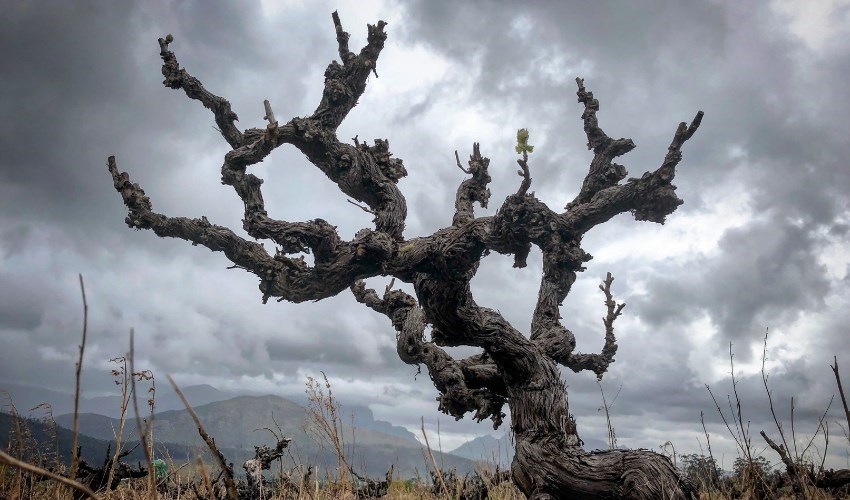
The Lötter Cinsault vineyards in Franschhoek, planted 1932. Both Andrea Mullineux and Lukas van Loggerenberg (Van Loggerenberg Wines) produces Cinsault wines from these old vines. Photo: Zach Moolman
A global movement
This reverence for ancient wood is not unique to South Africa; it is a global movement formalised by international initiatives like the London-based Old Vine Conference. Their last tasting, The Old Vine Conference: Heritage Showcase 2026 – one of the largest tastings of old-vine wines from around the world – was held on 8 June in London.
The effort to map the world's viticultural heritage recently hit a major milestone. The Old Vine Registry – a crowdsourced public database launched in 2023 – surpassed 10 000 registered vineyards across 42 countries.
Spanning over 40 900 hectares and 1 144 grape varieties, the registry operates on a simple premise: we cannot protect what we do not first identify.
This global push aligns with official momentum; the International Organisation of Vine and Wine (OIV) recently passed a resolution formally defining "old vines" as those 35 years or older, urging wine regions worldwide to catalogue and protect these historic living landmarks.
Around the world, pockets of viticultural history have survived against all odds, offering distinct flavour profiles shaped by extreme age.
On the volcanic island of Santorini in Greece, ungrafted Assyrtiko vines have been woven into low-to-the-ground kouloura (basket) shapes for centuries. Some of these rootstocks are over 200 to 400 years old, braving ferocious Aegean winds and desert-like droughts to yield whites with a haunting, saline, and razor-sharp minerality.
Meanwhile, in Australia's Barossa Valley, the regional Old Vine Charter protects historic Shiraz and Grenache blocks dating back to the 1840s. Because South Australia successfully quarantined itself from the devastating 19th-century phylloxera epidemic, these "Ancestor" vines remain on their original, un-grafted roots, delivering a seamless, velvety tannin structure and a concentrated depth of fruit that young vines simply cannot replicate.
From California's century-old Zinfandel "field blends" in Lodi to Spain's historic Garnacha, the global consensus is clear: age brings an unfakeable wisdom to the glass.
South Africa's liquid crown jewels
For South Africa, old vines are not just a point of pride; they are a primary driver of international premiumisation. South Africa boasts a priceless viticultural treasure trove: roughly 5 417 hectares of verified old vines (35 years or older). While this accounts for less than 6% of the country’s total vineyards, its footprint on the fine wine landscape is massive.
While there are over 39 varieties registered under heritage status in South Africa, a few key players dominate the old-vine conversation:
- Chenin Blanc (roughly 50% of OVP plantings): In older vines, the style beautifully shifts from simple, tropical fruit flavours to complex notes of honey, linear acidity, and a distinct, waxy lanolin mid-palate texture.
- Cinsault: This variety moves away from its historical reputation as a rustic blending partner and transforms into light-bodied, highly perfumed, elegant single-varietal masterpieces.
- Semillon and Palomino: These rare historical blocks yield hauntingly mineral, structured white wines with incredible aging potential, often sourced from dryland coastal regions like the West Coast and Citrusdalberg.
Geographically, Stellenbosch holds the largest absolute acreage of these heritage blocks, closely followed by the Swartland, Paarl, and Franschhoek.
Carel Nel, a sixth-generation winemaker at Boplaas Family Vineyards in Calitzdorp and a member of the prestigious Cape Winemakers Guild (CWG), cradles the history of the Klein Karoo in two remarkable old-vine wines.
The first is the Boplaas Hanepoot Block 1932, sourced from a vineyard planted nearly a century ago by Tom Brink. These resilient vines have stood their ground through a literal lifetime of floods, droughts, scorching winds, and political turbulence, yet they continue to deliver a wine of profound elegance.
The second bottling bridges history with Carel's own life: the Boplaas Block 1956 Hanepoot, harvested from a parcel Tom planted the very year Carel was born.
Today, these weathered survivors yield a meagre 3 tonnes per hectare. But what they lack in volume, they make up for in character. As Carel puts it, it is precisely this ancient, deep-rooted struggle that infuses the final wine with its unmistakable elegance and complexity.
Changing the economic narrative
Historically, old vines were a financial curse for primary grape growers. Because older vines produce lower yields, farmers selling to large co-operatives by the ton were financially penalised for keeping them in the ground. It simply made more financial sense to rip them out and plant high-yielding young clones.
The Old Vine Project fundamentally changed this dynamic by introducing the Certified Heritage Vineyard Seal in 2018 – a world-first official bottle sticker verifying that the wine is made from vines 35 years or older, complete with the specific planting date.
By turning "old vines" into a highly respected, traceable quality guarantee, the OVP has enabled winemakers to command premium prices on global stages. In turn, independent winemakers can afford to pay farmers a fair, sustainable price for their low-yield fruit. This ensures that the people who tend the land can afford to keep these living monuments alive.
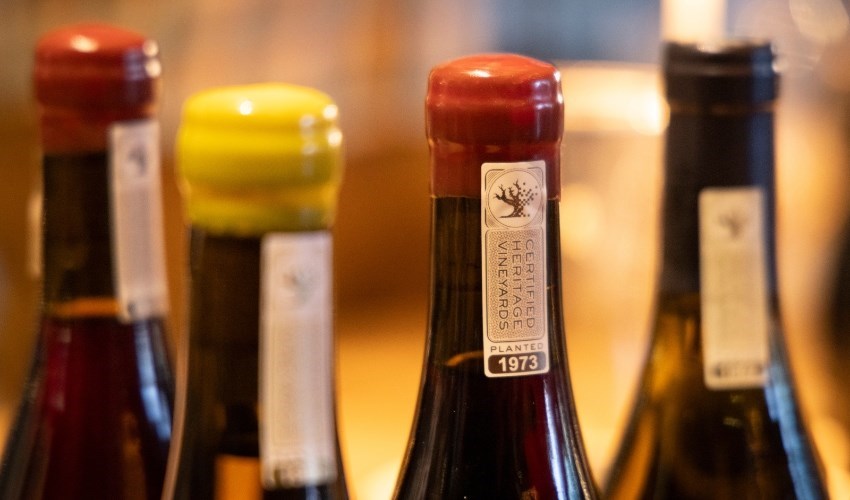
The Old Vine Project's Certified Heritage Vineyard Seals on wine bottles. Photo: Danie Nel
As climate change accelerates, these ancient plants are becoming vital tools for scientific study. Over decades of exposure, old vines undergo epigenetic adaptations – meaning they learn to adapt to environmental stresses and pass these resilient traits on to their cellular progeny. They are, quite literally, blueprints for the survival of modern viticulture.
Old vines matter because they preserve the genetic diversity of our winelands, protect our liquid history, and tell an authentic, unmanipulated story of terroir. They remind us that some things simply cannot be rushed – they must be earned through time.
But Bartho Eksteen, owner of Bartho Eksteen Wines in the Hemel-en-Aarde Valley and also a CWG member, cautions that not all old vineyards produce great wines. "Vine age alone is not enough. Some old vineyards continue to produce exceptional fruit decade after decade, while others simply don't. The real magic happens when age, site and stewardship come together.
"Old vines deserve respect, but they don't automatically deserve reverence. The proof is still in the glass."
That is when his tone shifts completely as he begins to talk about his latest project – a Franschhoek Semillon from a 121-year-old vineyard on La Bri, the very farm where he was born and raised. To be able to celebrate his 40th year in the wine industry in this exact way isn't just special; it feels like destiny.
"That's not just a wine," he says, "It's an experience. It's something that makes me relive my childhood, my school days, my army days, my Elsenburg days."
The 2025 Droom Semillon from this 1905 vineyard will be released in October. "That's also the price of the bottle, by the way," he adds with a sudden, mischievous chuckle.
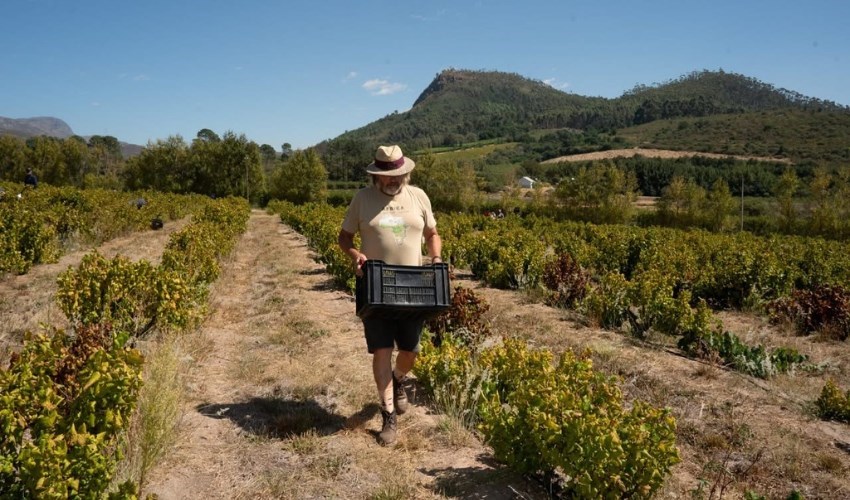
Bartho Eksteen harvesting grapes from the 121-year-old Semillon vineyard on La Bri Estate, Franschhoek.