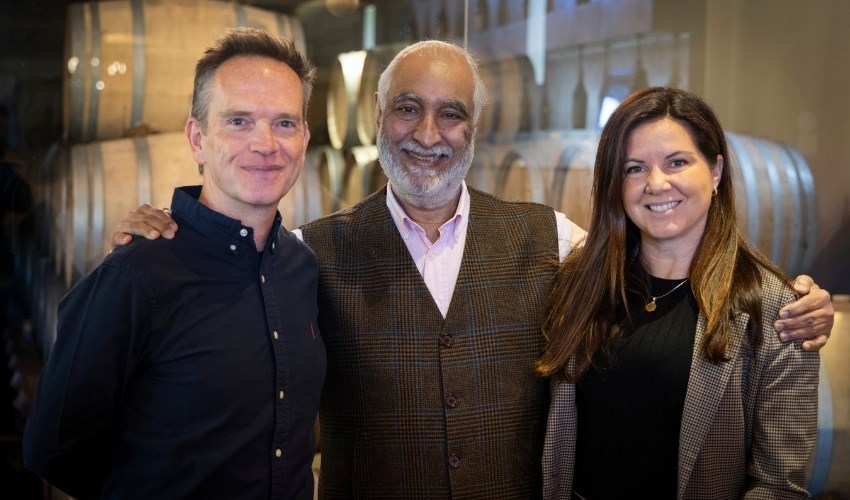
Chris and Andrea Mullineux, the power duo behind Leeu Passant, with Analjit "Bas" Singh, owner of the Leeu Collection.
It was a historic day when the Mullineuxs – owners of Mullineux Wines in the Swartland and the power duo behind Leeu Passant – hosted a vertical tasting of the first ten years of the Leeu Passant Chardonnay. The label is a collaboration with Analjit "Bas" Singh, owner of the Leeu Collection.
All these Chardonnays originate from a single vineyard planted in 1983, situated at an elevation of 400 m on the slopes of the Helderberg. Andrea noted that the grapes portray the "confidence" of an older vineyard – one that does not stress or "freak out" during exceptionally dry or wet seasons.
Chris and Andrea Mullineux fell in love with Chardonnay in Burgundy in 2004. When they partnered with Singh in 2013, their dream of producing some of South Africa’s finest Chardonnays began to take shape.
Their search for the perfect vineyard started, and the first Leeu Passant Chardonnay was produced in 2015. Over the past decade, this wine has garnered numerous five-star Platter’s ratings and consistently maintains a score of 96 points internationally.
Andrea Mullineux reflected on their journey as first-generation winemakers:
“We cannot just take advantage of 300 years of history or a great-great-great grandfather's journals to teach us what we know. Everything we do, every story we tell, every time we step into the vineyard is about learning, discovering, and cementing what we believe in and why we do what we do.”
The couple is deeply committed to all pillars of sustainability, managing the vineyards they lease from various growers using a regenerative organic style.
The influence of the ocean
The Helderberg vineyard is in close proximity to False Bay, benefiting from direct views and cold breezes throughout the season.
“Very rarely does it get above 28°C in this vineyard because of those breezes," Andrea explained. "There are also no radical shifts between day and night temperatures; it is just consistently cool. That is key for maintaining the racy acidity found across these wines – it’s a defining factor for us.”
While wind keeps the vineyard healthy, it can be a double-edged sword. Andrea noted that wind during the flowering phase can lower yields by up to 50%. Chardonnay is very, very volatile in how much crop it can produce or not produce, especially in terms of windy years.
“Most grapes are hermaphroditic. If you go into a vineyard in September or October, you will smell the beautiful flowers. They fertilize themselves under a little cap. If wind comes, it blows that cap off, the pollen floats away, and fertilisation stops. While this can be a natural reduction that improves density and bunch size, it also decreases the harvest.”
Pushing the limits
Chris and Andrea emphasized that the combination of low pH and healthy fruit allows them to craft wine in a style that truly represents what they love to drink.
With that "long, lean acidity," Chris explained, they can push the limits of the wine. "The intent is to make them the same way each year. Despite varying yields and climatic conditions, the idea is that this wine sees no sulphur for the first 18 months of its life. That low pH allows the wine to move into a much more saline, flinty territory."
The vertical was tasted from youngest to oldest to demonstrate the wines' evolution and aging potential. Both winemakers believe the 2024 vintage will continue to evolve for 15 to 20 years with careful cellaring.
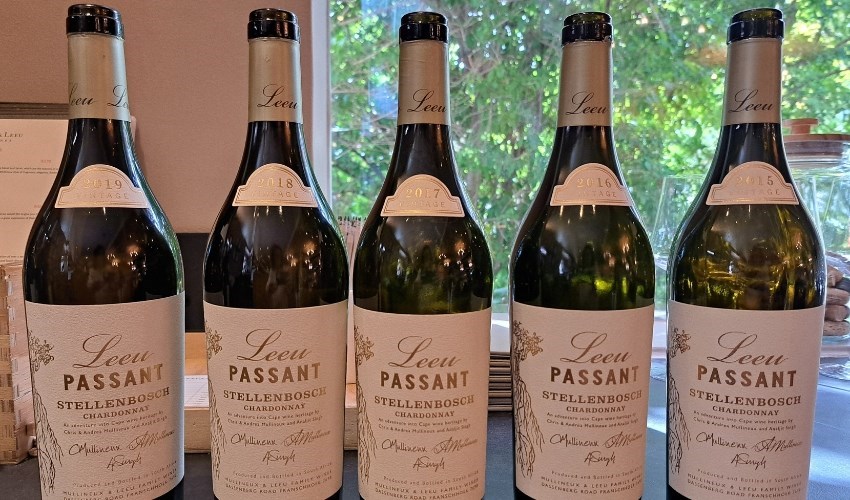
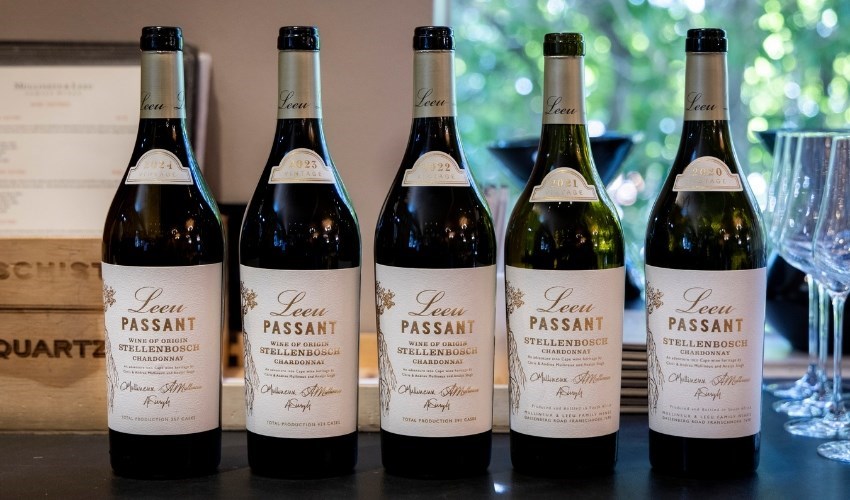
After the Chardonnay tasting from 2015 to 2024 vintages, guests could also taste the Leeu Passant new releases: the 2025 Franschhoek Sémillon (grapes from a 1963 vineyard); the 2024 Stellenbosch Chardonnay; the 2024 Wellington Cinsault (the oldest surviving Cinsault vineyard post phylloxera and planted in 1900); the 2024 Stellenbosch Cabernet Sauvignon; the 2023 The Leeu Passant (a blend of Cabernet Sauvignon, Cabernet Franc and Cinsault and inspired by the blends made in the fifites and sixties); and the 2020 Radicales Libres (Chardonnay matured for five years in French oak).
Chris added that the 2025 Franschhoek Sémillon is "the ultimate Franschhoek old-vine expression". Notably, it is the only wine in the stable aged in amphora rather than oak – a tribute to traditional winemaking methods used before oak barrels became industry standard in South Africa during the 1980s.
The day concluded with a pairing lunch at La Petite Colombe on Leeu Estates. The culinary team, led by head chef Peter Duncan, curated a seven-course menu specifically designed to elevate the unique character of each new release.