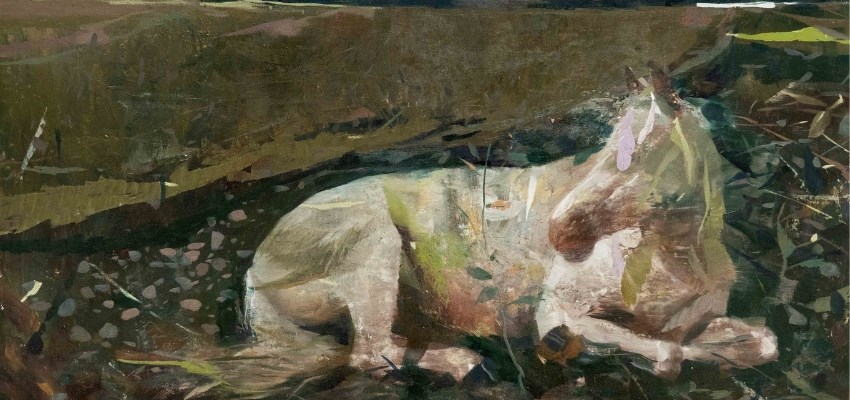
"Evensong" by Lars Elling.
Some ten years after first experiencing the South African light, acclaimed Norwegian artist and writer Lars Elling is preparing for his first exhibition in South Africa, a country where he spends five months each year on the De Rust farm in Elgin, home of Paul Clüver Family Wines. His exhibition, titled “Dreams of Reason”, opens on 11 April at the Everard Read Gallery on Leeu Estates in Franschhoek, and comprises works solely composed during his stays on the Clüver family farm in Elgin.
An artist for over three decades, Elling’s works are held internationally in major collections, including the Norwegian National Gallery and the European Union’s art collection, and have been exhibited across Europe and the United States. He has also found major success as a writer, having published four books since 2022, and the English translation of his debut novel is to be published in Spring with the title The Princes of Pauper’s Pond.
“Maybe the source material for my practice as an artist can be divided into three equal parts,” says Elling. “Memories, and especially those which are only half remembered. The ones with the fuzzy edges, well, I am partial to those. Only when these are slightly out of focus, can I reproduce them with perfect clarity.”
As a novelist, Elling draws in stories in his art. “Yes, both my own and your stories,” he says. “The writer in me makes me pick up on everything. Some stories become text, some become shapes and colour. Again, the edges are fuzzy. A good painting needs to be both a suggestion and a statement. And it has to be the bearer of a secret.”
And finally, there are artist’s physical surroundings.
“The light here in Elgin has changed my colour scheme from the dark grey greens of my native Norway, to the blues and ochres of the Western Cape. At the core, I remain the same, but different temperaments emerge with different surroundings.”
Elling’s paintings resist easy categorisation. They are neither fully realistic nor surreal, but exist in a liminal zone, what he describes as the fleeting state between sleep and wakefulness. It is here, in that fragile psychological space, that his imagery takes shape.
“I’m interested in that moment you pass through when waking,” he explains. “If you can hold onto it, you can visualise something that is not entirely real but not abstract either.”
Hence the naming of Elling’s forthcoming exhibition – "Dreams of Reason".
“The inspiration is "Dreams of Reason Produce Monsters", the title of an etching by the Spanish painter Francisco de Goya,” says Elling. “I’ve often wondered about that sentence. In Spanish, sueño means both sleep and dream. Is Goya saying: watch out for sleep, because your dreams might scare you? Or is he saying do not dream while awake, because your rationality will produce horrors. As in world domination, or the Holocaust…. I wonder. But I think Goya gets it. We are sense and we are sensibility and the most interesting images emerge through our lucid dreaming. ”
So where do the images for these works come from?
“If night is a dreamscape on the open sea, then daylight should constitute the terra firma of rationality,” he says. “To me, the unsure footing of the shallow shoreline, half asleep, half-awake is the most fertile ground for the mind’s images. Not the surrealism of dreams, where horses can fly, but the, half lucid imagery that belongs neither to night nor day. “
Elling has spent more than three decades as a painter, following a path defined less by networking or art-world visibility and more by an almost monastic commitment to the studio.
“I’ve never applied for a job. Never had a boss,” he says. “I’ve always just worked.”
His early career was built on whatever allowed him to keep painting: illustrating book covers, sketching courtroom scenes, even producing hand-painted signage. Elling’s path into art, as he recounts, was less a dramatic calling than a gradual realisation. A childhood spent drawing evolved into formal training, but it was only later - during Norway’s military service - that he consciously chose painting as a profession. The experience, which he described bluntly as deeply uninspiring, clarified his desire to pursue a more meaningful, creative life.
From there, his career expanded internationally.
Working for months at a stretch, often in isolation, he embraces long, uninterrupted days in the studio. “I like to keep the same frame of mind,” he says. “No distractions.”
That intensity is visible in his process. Paintings are not precious objects but evolving surfaces – sometimes entirely reworked or painted over if they fail to resolve. “If it doesn’t work, it’s gone,” he says simply.
If painting is Elling’s lifelong language, writing arrived unexpectedly and relatively late.
During the Covid-19 pandemic, following the sudden death of his father and the collapse of an exhibition, Elling found himself hesitant to paint. In response, he imposed strict rules: no internet, no distractions, no painting materials. Each day, he would sit and write.
The result was the first of several books and what began as an experiment has become an essential part of his creative life.
“I used to think I had to separate writing and painting,” he says. “Now I see they feed each other. They cross-pollinate.” Painting and writing are not separate disciplines but interwoven acts of seeing. One begins in the eye, the other in language, yet both emerge from the same interior landscape of memory, imagination and lived experience.
His fiction, like his paintings, is rooted in memory, often exploring personal histories and psychological tensions. One recurring narrative thread centres on a fractured relationship between two brothers, drawn from his own childhood environment. The story unfolds not through action but through accumulation, detail and emotional undercurrent.
“Nothing dramatic happens,” he says. “But everything is there.”
Elling is currently working with a London-based translator on the English version of his novel, a process he describes not as translation, but rewriting.
“It’s like revisiting your own text,” he says. “You realise how differently you would have written it in another language.”
This sensitivity to nuance mirrors his painterly approach: both rely on precision, tone and the ability to capture something elusive without over-defining it.
Despite his international exhibition history – spanning cities from Berlin to New York – Elling remains sceptical of the social machinery of the art world.
“I’ve never believed in networking,” he says. “The work has to speak.”
Instead, he aligns himself with a quieter tradition, one that values observation, discipline and the slow evolution of a personal language. His influences range from visual art to music, particularly jazz, with its emphasis on improvisation within structure.
“Improvisation is important,” he notes. “But it has to come from something solid.”
What ultimately defines Lars Elling is not just his versatility, but the coherence between his different modes of expression. Whether painting or writing, he is engaged in the same pursuit: making visible what lies just beneath the surface of experience.
“There were gaps before,” he reflects. “Writing filled them. It expanded the world I was working in.”
This weekend (10-12 April 2026), Elling’s exhibition will be opened by Dr Paul Clüver, third-generation proprietor of De Rust Estate and Paul Clüver Family Wines, to whom the artist was introduced a decade ago by mutual Norwegian friend, the culinary expert Andreas Viestad.
“I expressed an interest in having a place to work in in the Cape summer during the Norwegian winter, and Dr Clüver and his wife, Songvei – also of Norwegian heritage – were kind enough to open their farm to me, where I have been given the use of one of the farm cottages to work in,” says Elling. “This Elgin setting has contributed to my growth and progress as an artist, and I look forward to exhibiting the fruits of this in the new show.”