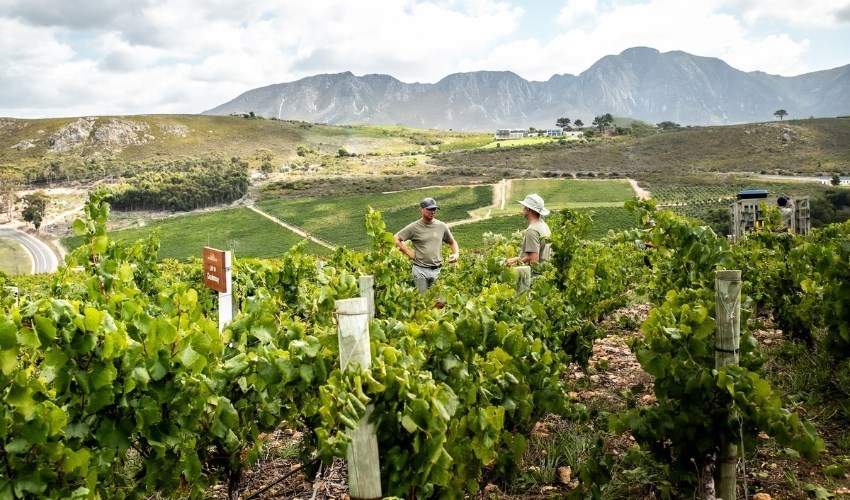
The 2026 harvest at Bouchard Finlayson will be remembered as a vintage defined by contrast, requiring precision, adaptability and resolve in equal measure. Set within the cool-climate conditions of the Hemel-en-Aarde Valley, the season presented a series of distinct challenges that ultimately shaped a nuanced and promising crop.
A notably dry growing season, particularly between October and December, marked the early stages of the vintage. Among the driest periods in over a decade, these conditions necessitated meticulous irrigation management to maintain vine balance.
As Winemaker Chris Albrecht explains, “There is a fine balance between stressing the vineyard and it being in too good a condition. It shouldn’t thrive… you want the vine to focus its energy on the fruit.” This careful calibration proved critical in preserving concentration and character in the berries.
Despite the dry conditions, the early harvest period showed considerable promise. Yields were healthy, and the fruit arriving in the cellar was described as clean and well-balanced, fermenting with encouraging natural acidity and moderate alcohol levels. “The earlier part of the harvest was beautiful,” notes Albrecht. “There was a healthy crop – a good amount of fruit to work with, which is always a positive starting point.”
However, the season did not follow a predictable trajectory. Uneven ripening patterns across vineyard blocks required constant monitoring and flexible decision-making. Each revealed itself in its own time, requiring observation, patience and a willingness to adapt. The year was a reminder of the imperative of working with nature, not against it, allowing each vineyard to guide us towards its own unique expression.
The defining moment of the vintage arrived in early February, when an unprecedented rainfall event reshaped the latter half of harvest. In anticipation of an incoming storm, the team made the unusual decision to harvest the Heritage vineyard on a Sunday – an unprecedented move. “That will always be a reminder of what is required in harvest-time and what our team is capable of,” says Albrecht. What followed was over 140mm of rain within 70 hours, preceded by high humidity – conditions more akin to a tropical climate than the Cape’s typically temperate summer.
This event effectively divided the vintage into two distinct phases: before and after 10 February. Crucially, the majority of Pinot Noir, Chardonnay and a significant portion of Sauvignon Blanc had already been harvested, preserving the integrity of these parcels. Later-ripening varieties, including Riesling and Sangiovese, required rigorous sorting and careful cellar work to maintain quality.
Concerns around regional wildfires earlier in the season ultimately proved unfounded, with no evidence of smoke taint detected during fermentation.
Reflecting on the season as a whole, Albrecht is upbeat: “Personally, I’m excited. There are lots of good things that have come from this vintage. We’re always asking questions and trying new things. I definitely think we’ve got a lot of new material to work with, and I’m excited to see how it evolves.”
While 2026 demanded vigilance and adaptability, the result will be wines of character, tension and depth – hallmarks of our distinctive corner of the Cape.
Harvest at a glance
- Picking commenced on 26 January and continued until 12 March.
- Aside from the storm on 10 February, when 140 mm was recorded, total rainfall was typical for the period and in line with expectations.
- All Chardonnay and Pinot Noir vineyards were picked early in the morning, with the Pinot Noir grapes stored in a cold room overnight and processed the following day.
- Cropping levels are controlled during the growing season to ensure balanced vines. Factors such as individual canopy size, weather conditions, bunch count and size are considered when determining final yields. Single and heritage vineyards typically yield well below the average. This enhances the expression of site and density of flavours.
- The 2026 vintage showed above-average fertility and vigour during the Spring and early Summer. More than one action was needed to control vigour and cropping levels to maintain balanced vines. Most vineyards were allowed to crop slightly above the long-term average due to healthy, large canopies. The farm yielded 15% above the long-term average.