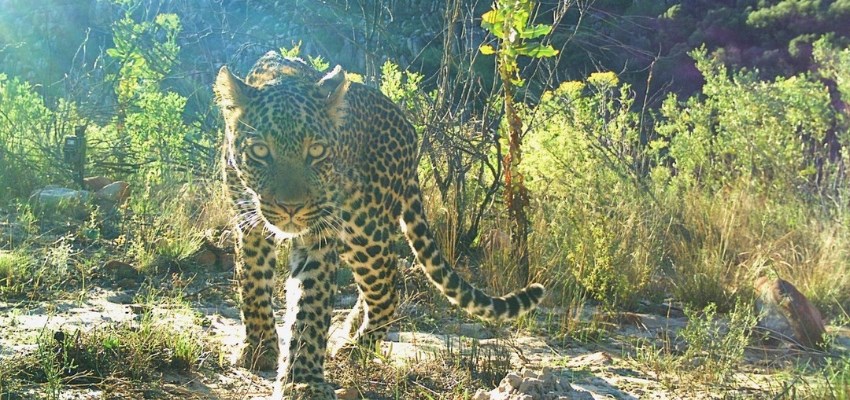
High on the granite slopes of the Simonsberg Mountain, above rows of vines that have been tended for generations, something extraordinary moves through the fynbos at night. The leopard – secretive, solitary, and perfectly adapted to these rugged mountains – is one of South Africa's most elusive predators. And in the Cape Winelands, winemakers and private landowners are some of the most committed champions of its survival, aiding the efforts of dedicated conservation organisations.
Among them is Nora Thiel, executive director of Delheim Wine Estate in Stellenbosch and chair of the Greater Simonsberg Conservancy (GSC). For Nora and Delheim, conservation is not an afterthought – it is woven into the very fabric of how the farm operates. "Being part of the Greater Simonsberg Conservancy allows us to contribute to conservation beyond our farm boundaries," she says. "We are proud to support efforts that protect this unique natural heritage, showing the care of and for and appreciation of the environment as past generations have. We are but custodians for the region’s future farmers."
A mountain full of secrets
Leopards occur all along the mountainous regions of the Cape Fold Belt in the Western, Eastern and Northern Cape. These leopards of the Cape are physically smaller and weigh less than their savannah cousins, and are highly adapted to the rocky terrain and dense fynbos of ranges like the Boland Mountain Complex, of which Simonsberg forms part. They are also under pressure – from habitat loss, human-wildlife conflict, and illegal snaring – and their exact numbers remain uncertain.
That uncertainty is precisely what the Cape Leopard Trust (CLT) set out to address. Between 2010 and 2012, the CLT conducted the first intensive large-scale survey of leopards in the Boland Mountain Complex, establishing a critical population baseline across some 2 500 square kilometres of mountain landscape, including protected areas and private properties. More than a decade later, the CLT returned to conduct a comprehensive re-survey, and the results were both reassuring and sobering: leopards are still there, their territories overlapping with farm boundaries, hiking trails, and wine estates. But their survival depends on what happens next.
Where wine country meets wild country
The Greater Simonsberg Conservancy (CSC), which includes Delheim among its member properties, formed an important part of the CLT's re-survey. Camera traps were deployed on several estates, including Boschendal, Plaisir, and Delheim, capturing photographic evidence of leopard presence along the Simonsberg slopes. This data confirms what conservationists had long hoped: the mountains above the vineyards continue to serve as vital ecological corridors, linking protected areas and allowing leopards to move through the landscape.
Over the past fifteen years, the CLT has monitored multiple leopards whose territories overlap with the Conservancy's landholdings. The ongoing presence and movement of adult leopards through these private properties underscores a truth that Nora articulates with clarity: "The Greater Simonsberg Conservancy is built on the belief that meaningful conservation happens when landowners work together at a landscape level. The presence of leopards in the broader Simonsberg area is a powerful reminder of why sustainable land management matters."
In 2025, the GSC demonstrated that commitment in concrete terms, donating R50 000 to the CLT – funds raised at the Absa Cape Epic MTB event – to support research, conservation, and education initiatives. It is the kind of collaboration that makes conservation viable in a region where wild and cultivated land coexist in close proximity.
Snares, schools, and smarter kraals
Protecting leopards in the winelands is not only about camera traps and corridors. One of the most pressing threats in the region is the illegal setting of snares, which indiscriminately trap predators and prey alike. In 2023, the CLT launched its Snare Free Hotline and began facilitating awareness workshops for GSC members – a practical intervention aimed at changing behaviour on the ground, one farm at a time.
The CLT's education team has also been active within the Conservancy, running eco-club lessons, school presentations, and educational outings that bring young people into the conversation about coexistence. Conservation, after all, is generational work.
Perhaps the most innovative initiative to emerge in the field of leopard conservation over the past few years is the Mobi-kraal project – a programme to develop affordable, mobile predator-proof livestock enclosures that reduce the incentive for retaliatory killing of leopards. In 2025, Boschendal, another GSC member property, became the first test site to receive a prototype. The message is clear: with the right tools and partnerships, agriculture and conservation do not have to be in conflict.
Walk for the Wild: Lacing up for leopards
On 9 May 2026, Delheim Wine Estate will open its mountain trails to hikers and trail runners for the inaugural Walk for the Wild – a fundraising event in support of the Cape Leopard Trust and the Simonsberg Conservancy. Participants can expect a 10-kilometre route through moderate, well-maintained terrain, with elevated sections offering sweeping views over the Stellenbosch valley. Trail runners must start promptly at 08h00, while hikers enjoy a rolling start between 08h00 and 10h00.
Tickets are priced at R450 per person and are bookable via Quicket. The event promises more than a morning on the mountain: it is a chance to walk through leopard country with purpose, to understand the landscape these animals navigate, and to contribute directly to their protection. Participants will learn about leopards and the conservation work being done.