Our understanding of trees is in its infancy. While we’ve literally and metaphorically leaned on trees for millennia as sources of shelter, inspiration, and shade, in recent years, scientists have begun to reveal just how little we know about these carbon-busting powerhouses.
In addition to acting as the earth’s lungs and hosting thousands of species of insects and animals (and around 1 trillion microbes), trees are social creatures that communicate with each other via their roots. Ancient solar storms can be documented through their rings and forecast new ones, and protecting trees can actually lower the incidence of mosquito-borne disease in the tropics.
Trees are pretty amazing. But we’re here to talk wine.
And as it turns out, trees also have an outsize effect on the flavors and aromas in your favorite glass of wine. So let’s explore what vintners actually know, think they know, and speculate on potentially thinking they know about how trees influence vineyard health and ultimately wine flavor, while also keeping in mind that there is still so much we still just don’t yet know.
Trees moderate temperature and boost biodiversity
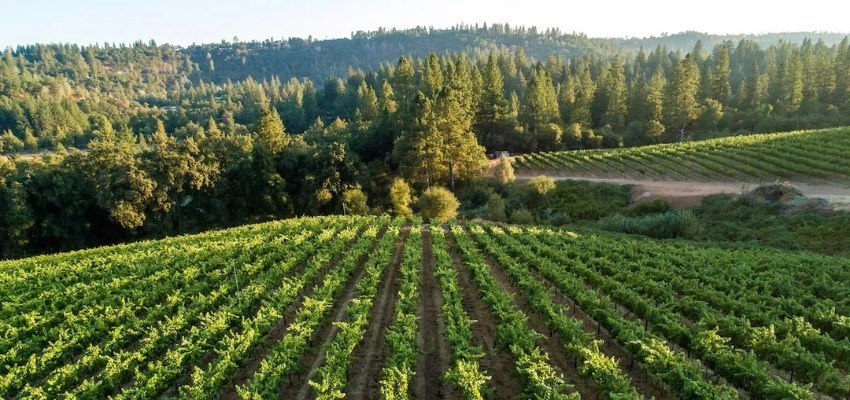
Trees bring the world of the forest to the vines, and also provide a natural, free of charge air-conditioning and wind-protection system.
“We have only 140 acres of Chardonnay and Pinot Noir planted on a 317-acre property, and we are surrounded by millions of acres of wilderness and forest, primarily Douglas fir, Oregon white oak, and big leaf maple,” says Gretchen Boock, general manager at Benton Lane Winery in the Willamette Valley. “We have extreme biodiversity and that keeps our ecosystem in balance.”
The team collected data from their vineyard for five years, and the findings show that the presence of trees had a measurable impact on the actual temperature and health of their vines.
Compared with the rest of the McMinnville American Viticultural Area (AVA) within the Willamette Valley, Benton Lane had 50% fewer days over 90 degrees Fahrenheit and 76% fewer days over 100 degrees.
“Our forest buffers us from these heat spikes, which are detrimental to the health and quality of our grapes and wine,” says Boock.
Click HERE to read the full article.