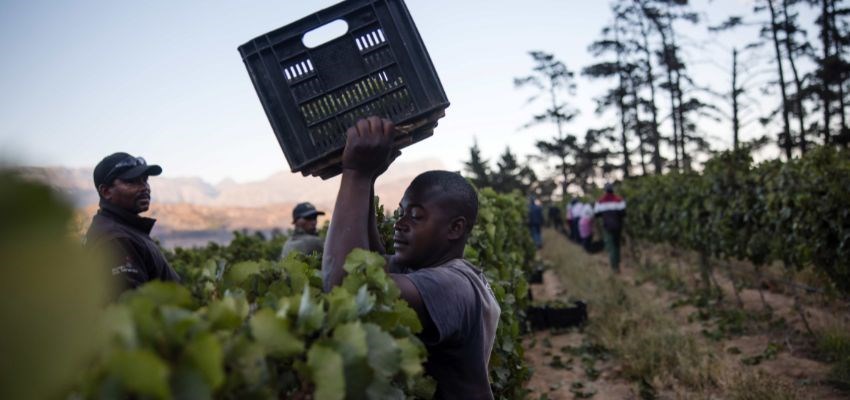
The 2026 wine grape harvest at Chamonix Wine Estate in Franschhoek will be remembered as one of those vintages where timing, climate and vine physiology aligned with reassuring precision. It was an early harvest, certainly – between ten and fourteen days ahead of the long-term average – but one shaped less by haste than by balance, resilience and an underlying calm in the vineyards.
Hot and dry conditions dominated the spring and summer months, accelerating vine development and bringing ripening forward across cultivars. Yet the season’s defining influence lay earlier, in a preceding winter cold enough to push the vines into a deep and complete dormancy. “That full physiological shutdown proved decisive,” says Chamonix winemaker Neil Bruwer. “When growth began in Spring, the vines did so evenly and with vigour, setting the tone for what would follow.”
Bud-break, flowering and berry-set unfolded under mild to warm conditions, ideal for uniform development and healthy fruit formation. By the time the heat arrived in earnest during November, December and January, the vineyards were already well established, with strong canopies and excellent fruit exposure. “Despite the dryness of the mid-summer period, yields were not compromised,” says Bruwer. “On the contrary, crop levels are up on the previous vintage, and disease pressure was virtually absent across the farm.”
Harvest began early in January with Pinot Noir destined for rosé. On 9 January, estate-grown Pinot Noir was pressed, capturing bright aromatics and delicate phenolics at modest sugar levels. Chardonnay followed soon after, with picking running from 16 January through to 29 January. “The Chardonnay crop from Chamonix’s own Franschhoek vineyards delivered average yields of between nine and eleven tons per hectare, a generous outcome given the season’s warmth, and one achieved without dilution of flavour,” says Bruwer.
Sauvignon Blanc harvest commenced on 26 January, also averaging nine to eleven tons per hectare. “The fruit arrived in excellent condition, with sugars comfortably above 22 degrees Balling and no signs of physiological stress,” says Bruwer. “Acidity levels were notably firm, particularly in younger vineyards, while pH readings remained reassuringly low. There was no ‘drop-out’ in the vineyards – no sudden collapse in acidity or freshness – a common risk in hot, dry years that simply did not materialise in 2026.”
Pinot Noir for red wine entered the cellar in February. Purchased fruit from Franschhoek arrived on 5 February, followed by Elgin-sourced Pinot Noir on 18 February, adding cool-climate tension and aromatic lift to the Chamonix blends. The estate’s famous Old Vine Steen vineyard was harvested later, on 20 February, benefiting from a longer hang time and steady physiological ripening.
Cabernet Franc came in on 19 February, showing fine tannin development and aromatic clarity, while Cabernet Sauvignon was still on the vine at the time of reporting, progressing steadily toward optimal ripeness. The late-season reds have benefited from the same disease-free conditions that characterised the whites, with clean canopies and evenly ripened bunches.
“In qualitative terms, the 2026 vintage stands out for its precision,” says Bruwer. “Sugars accumulated steadily rather than spiking, acids held firm, and flavour development was intense without veering into overripeness. The wines promise concentration without heaviness, structure without austerity. There is a quiet confidence among the viticultural and cellar teams that this is a stronger harvest than 2025 – and that is saying something, as 2025 itself was widely regarded as a very good vintage.”
What distinguishes 2026 at Chamonix is not simply the quality of the fruit, but the way the vineyards handled stress. Deep winter dormancy, even early-season growth and timely ripening all contributed to vines that coped admirably with heat and dryness. The result is fruit of poise and clarity, shaped by the season but not dominated by it.