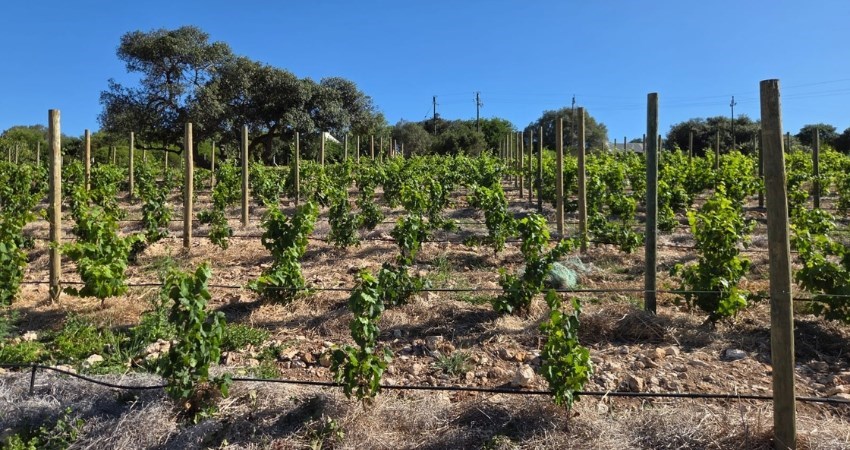
Young Pinot Noir vines newly established at Wild Olive Guest Farm, Stilbaai.
“This is true pioneering territory. There isn’t much virgin land in South Africa that is still suitable for viticulture,” says Jaco Engelbrecht, one of the country’s leading viticulturists. He’s referring to two new designations in the Cape South Coast region, adding Stilbaai district, and Goukou River Valley as its ward. Both are expected to be officially gazetted as Wine of Origin areas in March this year.
It’s a project Engelbrecht has been working on for more than 15 years. The area has held meaning for him since childhood visits to his grandparents, who lived here for over three decades, and later mountain-bike rides through its hills. “I’ve always known I wanted vineyards here. You can just feel it’s special.”
Guarantee of origin
The Cape South Coast runs along the Indian Ocean coastline and, while it accounts for only around 1% of the country’s wine grape production, it is proving to be one of the most exciting demarcations for fine wine, thanks to its ocean-cooled vineyards and marginal soils. It currently comprises seven districts: Elgin, Overberg, Walker Bay, Swellendam, Lower Duivenhoks River, Plettenberg Bay and Cape Agulhas. Stilbaai is set to become its eighth.
The Cape South Coast continues to refine its boundaries. Within the Walker Bay district, the newly designated wards of Hartbeest River and Shaw’s Mountain have now been added to the roll, further tightening the region’s focus on site-specific, quality-driven viticulture.
South Africa’s Wine of Origin (WO) scheme was established in 1973 to safeguard provenance and bring formal structure to labelling. Then it was the first system of its kind outside Europe. It works by demarcating production areas in descending order of size: regions, districts, then wards. It’s also used to certify the vintage and variety on the label. Though the system does not dictate varieties or winemaking methods, but rather where grapes are grown.
Like a Russian nesting doll, each tier narrows the focus. A region contains districts, such as Stilbaai, which in turn delineates into wards, like Goukou River Valley, which are the most site-specific level of the hierarchy, typically defined by distinctive soils and/or mesoclimates.
Finally, to carry a WO seal, 100% of the grapes must come from the stated area, 85% from the vintage, and 85% of the declared variety if named.
The soils are the first thing that excited Engelbrecht: “It’s the biggest driver for stylistically what’s going to happen,” he says, describing it as the purest limestone he has encountered in decades of digging vineyard sites. Together with a small group of collaborators, he lobbied for what was then known as the Stilbaai East ward to be renamed and expanded into the Stilbaai district, allowing for a broader and more coherent demarcation.
“It’s not the easiest place to farm,” Engelbrecht admits. Breaking through limestone demands planning and patience. “But that’s exactly why it could be interesting,” he says of the calcareous terrain. “There’s barely any topsoil, just massive deposits of limestone on both sides of the estuary. You can’t arrive with a bulldozer and hope for the best.”
Instead, he and his team have spent more than a decade mapping the area using precision viticulture tools, including GIS aerial surveys and detailed soil profiling. Alongside the pure limestone are pockets of limestone-shale.
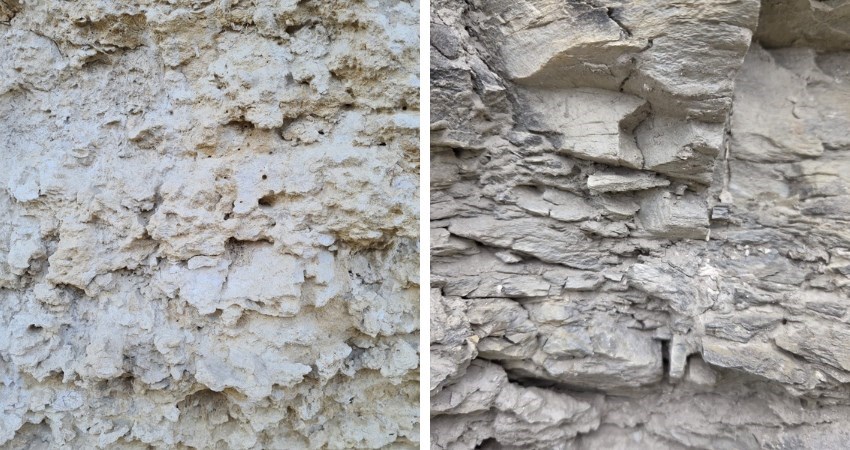
The soils are the primary stylistic driver here. Pictured: (L) Calcarenite – a sedimentary rock of sand-sized carbonate grains, predominantly calcium carbonate (calcite); (R) shale with high levels of calcium carbonate.
He has no illusions about scale; this is not meant to become the next Stellenbosch. If anything, he prefers it remains focused on fine wine rather than broad commercial expansion, cautioning against large companies consolidating vast tracts. A Burgundian model, small sites in the hands of committed farmers, feels far more appropriate.
Tiny Burgundy
Beyond the soils, it is the pronounced diurnal shift that sets the area apart. “For a coastal town it gets ridiculously cold,” Engelbrecht says. The Goukou River plays a significant role.
He has recorded consistently low night-time temperatures, often hovering around 4°C and dipping lower in mid-winter. “This allows the vines a proper dormancy.” In other regions, he notes, insufficient winter chill has become a concern, with vines failing to fully reset. Sustained cold enables the plant to shut down, conserve energy and complete the physiological processes that regulate bud break and flowering. Adequate cold units promote even growth, balanced yields and healthy shoot development; without them, uneven ripening and long-term vine stress can follow.
Frost, of course, is a risk. But it is one they are preparing for, adopting Guyot training as in Burgundy and delaying pruning to mitigate potential damage. It is the same logic that has guided variety selection. The cool temperatures and lean soils point naturally to early-ripening chardonnay and pinot noir, which he sees as the likely flag-bearers for the area.
“We need to take things slowly,” he says. “Plant the right grapes in the right sites and allow the vineyards to mature. Only then will the district speak for itself. We can’t rush this to market.”
Plantings remain minimal for now, totalling just under 10 hectares across the broader area, with Engelbrecht and his team responsible for four of those.
The holdings of which are small and not run by conventional wine farmers. Most of the landowners are over 50 with other business interests; none farm full-time. What unites them is a deep attachment to the area and a shared ambition to grow vines and, in time, produce wines of their own.
The group includes Herman van As of Rustfontein, who plans to plant Pinot Noir next year; John Harding of Wild Olive, where Pinot Noir and a small parcel of Chardonnay have just gone into the ground; Kasper van Rooyen, Harding’s son-in-law and a macadamia farmer from Mpumalanga; Anthony Cawood of Goukou Ridge Farm; Niel Stephens of Witkranz; Phil Couchman of Long Thin Farm; and Jonjon Visser of Stonehaven River Lodge.
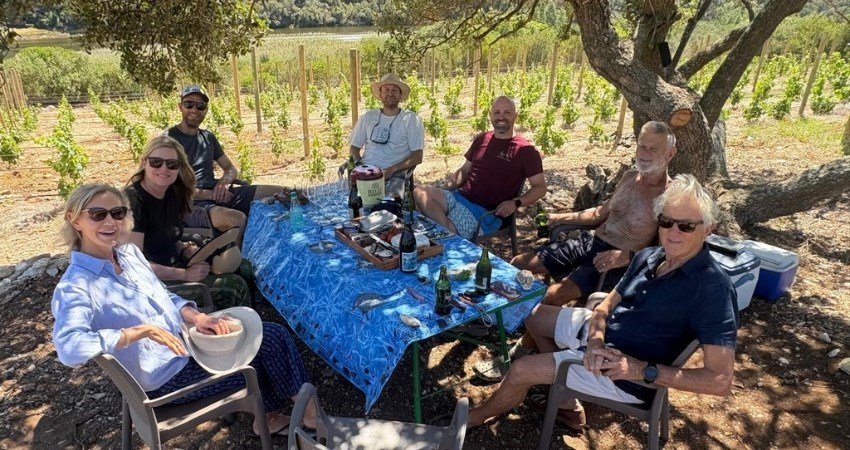
Meetings along the Goukou River, where like-minded landowners gathered to host discussions last year.
Stilbaai has also long attracted the broader wine fraternity. Many own holiday homes here or return annually to surf, with the Vintners’ Classic, the industry’s informal surfing gathering, hosted on its beaches each year.
Now that they’ve managed to break through the honeycomb-like limestone, Engelbrecht says the next big challenge will be keeping the birds away from the grapes. He says they’re addressing this through provisions in the trellising system to accommodate protective netting.
Plantings are tiny, the learning curve steep, and the timelines long. But Engelbrecht is clear about the end goal: “When we finally put our pinots and chardonnay on the table, they’ll know what we know, that this place is something special.”