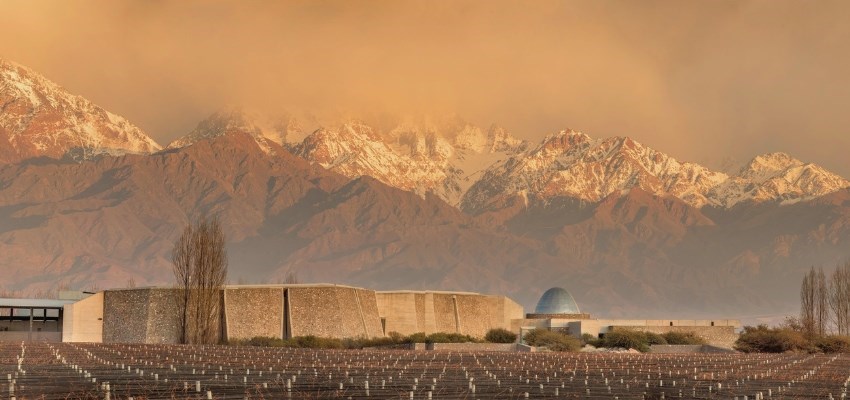
"We’re more than Malbec" was the resounding theme of Vinexpo Explorer Mendoza 2025, with Argentine producers amid the Andes’ snowcapped peaks, from Luján de Cuyo to the Uco Valley, eager to show off sparkling wines as key weapons in their arsenals. From long-aged traditional method fizz to premium cuvées and no- and low-alcohol innovations, the category is rapidly evolving. With Argentine wine sales falling 2.5% from January to September 2025 versus the same period a year prior, according to the National Institute of Viticulture, and consumers increasingly falling out of love with red wine, could bubbles be a bright spot?
“For many Argentinian wineries, sparkling wine production represents an opportunity to diversify their portfolios, particularly beyond Malbec,” explains Morgane Pont-Bruyns, head of communications at Moët Hennessy-owned Chandon, whose NV Rosé won Best Argentine Sparkling Wine at London’s Champagne and Sparkling Wine World Championships 2025. “It also allows them to tap into the premium segment of the market, enhancing Argentina’s reputation as a sophisticated wine-producing nation.” For years, Argentina has been trying to shed the ‘supermarket wine’ stereotype.
And after a week of tastings, vineyard trips and seminars, 80 buyers from across Asia, Europe and the Americas who attended Vinexpo Explorer Mendoza 2025 admitted that they had “underestimated Mendoza”, and were wowed by the burgeoning focus on premiumisation, boosted by the sheer diversity of soil, varieties and terroir. “Regions like Mendoza offer diverse microclimates and altitudes that are incredibly well-suited for growing traditional sparkling wine grape varieties like Chardonnay, Pinot Noir and even local varieties such as Semillon, Petit Manseng and Malbec, which we incorporate to express unique regional characteristics,” adds Pont-Bruyns.
The winery owns 400 hectares of vineyards in the area, at altitudes as high as 1,700m. “The significant diurnal temperature range helps maintain the acidity crucial for making quality sparkling wines,” says Pont-Bruyns. For Zuccardi’s winemaking director Sebastián Zuccardi, a key reason Argentina’s producers are making more fizz is because they are cottoning onto the “outstanding potential” of the Uco Valley, which has enjoyed a boom in investment over recent decades. Located around 100km south of Mendoza, the high-desert appellation is defined by elevations of up to 1,700m, as well as warm sunshine, cold nights and alluvial soils with limestone, all enhanced by the surrounding snowy mountains.
Family-owned Zuccardi has been making sparkling since 1999, after Zuccardi and four friends launched the fizz-focused Alma 4 project. This prompted the family to explore cooler areas with higher natural acidity, guiding them to the Uco Valley. Today, Zuccardi has eight vineyards there, as well as its winery. “Thanks to the elevation, we can grow grapes in cool or very cool climates, on soils that provide remarkable complexity and texture,” adds Zuccardi. Cavas Rosell Boher’s Patricio Vazquez also credits the Uco region for the “freshness, precision and balance” of his boutique wines. Within the broader Mendoza region, he sees “a clear move toward more restrained winemaking, letting freshness and texture speak, rather than overt winemaking signatures”.
Click HERE to read the full article.