Its authority lies not in amplitude but in proportion, not in spectacle but in the slow persuasion of balance: fruit finding its measure against texture, acidity and tannin, each aware of the other, none insisting on primacy.
This remains an uneasy lesson in places where size and intensity have too often been mistaken for depth. Yet there are producers who seem to grasp Pinot Noir’s temperament instinctively, as if by listening rather than by design. Paul Clüver Family Wines is among the few in South Africa who have learned that Pinot Noir does not reward insistence; it responds to patience. The release of the Paul Clüver Estate Pinot Noir 2024 quietly reinforces both Elgin’s aptitude for the grape and Clüver’s long, attentive custodianship of it.
That the wine has earned five stars in the 2026 Platter’s Wine Guide is less a surprise than a confirmation. Recognition tends to follow wines that are already complete in themselves. What distinguishes the 2024 vintage is not greater drama, but a sharpening of focus, a clarity that feels earned rather than engineered. The wine offers immediate pleasure, yes, but also the sense that its shape is secure, that it knows where it is going.
The season that produced it did not conform to Elgin’s usual script. Warm, dry conditions arrived early, compressing the cycle and pulling harvest into the first week of February. For Pinot Noir, such circumstances can easily push the wine out of tune. Yet Elgin’s real advantage — altitude — asserted itself at the margins that matter most. Vineyards between 280 and 400 metres retained their nights, their pauses, their capacity to slow things down. Sugars advanced, but aromas stayed lucid, acidity intact. The ocean, some 20 kilometres away, undoubtedly plays its part, though its influence is better felt in the glass than proclaimed in marketing copy.
Winemaker Andries Burger speaks of small berries and thicker skins, a combination that might suggest power, yet here results instead in density without heaviness. Careful early-morning picking and overnight cooling preserved the fruit’s composure. Nothing was hurried. Nothing was asked to be more than it was.
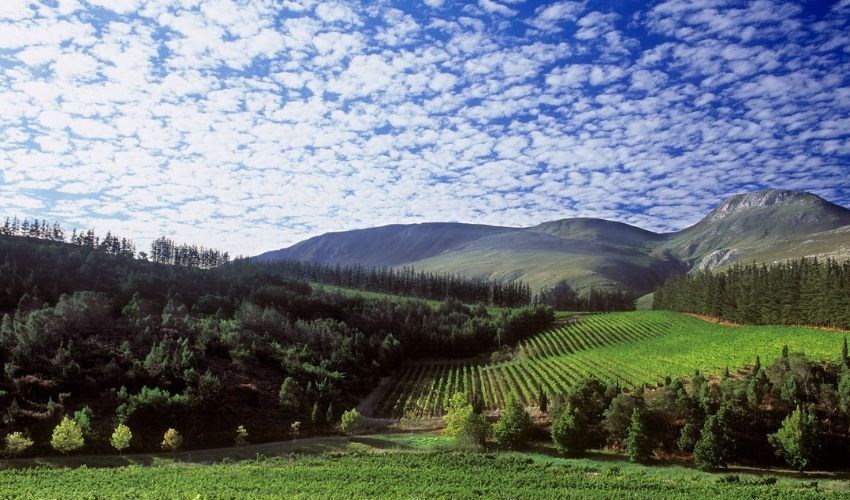
The vineyards themselves explain much. Just under 22 hectares of Pinot Noir are planted with a distinctly Burgundian mindset: multiple clones, varied vine ages, an acceptance that complexity comes from difference rather than uniformity. Some vines are barely out of adolescence; others have been in the ground for more than thirty years. Rooted in decomposed Bokkeveld shale with clay inclusions, they lend the wines a quiet firmness, a kind of inward tension that does not need to announce itself.
In the cellar, restraint continues the conversation begun in the vineyard. Double sorting, whole berries, small wooden fermenters, a modest cold soak… each step seems intended less to shape the wine than to avoid interfering with it. Natural fermentation leads, cultured yeasts follow. Extraction is gentle, almost conversational. Twelve months in French oak, only a fifth of it new, provides context rather than commentary. Even the final racking, done under nitrogen, feels like an act of care rather than control.
The wine itself is bright rather than dark, its crimson hue suggesting energy more than mass. Aromatically, it opens with dark cherry and damson, touched by all-spice and a faint, grounding earthiness. On the palate it moves with ease, supple, but not slack; poised, but not severe. Acidity traces the line, tannins offer texture without insistence. Nothing clamours for attention. Instead, the wine reveals itself in increments, rewarding attentiveness.
This is ultimately where the 2024 Estate Pinot Noir persuades. Pinot Noir cannot be reduced to a single virtue. Fruit alone is easy. Structure alone is sterile. What matters is alignment, that aura-commanding space when flavour, texture, freshness and tannin recognise one another and move together. Here, that alignment feels unforced, almost casual, as if it were the most natural outcome in the world.
South Africa’s Pinot Noir fraternity remains small, and perhaps must remain so. The grape has little tolerance for shortcuts or impatience. Paul Clüver stands among those who understand this, not as a theory, but as a practice sustained over time. The 2024 Estate Pinot Noir does not perform, nor does it posture. It avoids both ripeness for its own sake and austerity as fashion. What it offers instead is something quieter, and rarer: assurance without arrogance.
In a season that asked questions, Paul Clüver has answered with a Pinot Noir that listens as much as it speaks. It is Elgin, clearly articulated. And Pinot Noir, once again, reminding us that persuasion is its most enduring strength.
This article was originally published on Wine Goggle, Emile Joubert's blog.