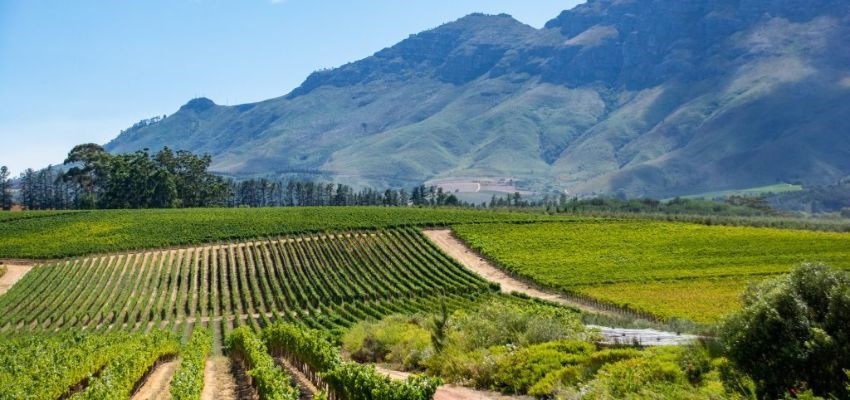
For most winemakers, the closest they get to selling their creations is the odd tasting or masterclass for trade and press. Not so for Glenelly’s Dirk Van Zyl, whose full job title is cellar master and African sales manager – roles he inherited from his predecessor, Luke O’Cuinneagain, when he joined the Stellenbosch estate in August 2022.
“It was a huge challenge at first, but I’m definitely a far better winemaker because I have to do that,” he says with a smile. “You get a bit more honest feedback on your wines when you have to sell them. We don’t make wines in a vacuum – it’s not like we make them and they just walk off the farm. They have to work in the market.”
When Van Zyl joined Glenelly – a former plum farm acquired in 2003 as the ‘retirement project’ of the remarkable May-Éliane de Lencquesaing, who celebrated her 100th birthday this year – he wasn’t, at first, in a rush to fundamentally change anything. “It’s easy to go into a new place and say: ‘This doesn’t make sense, this doesn’t make sense, this doesn’t make sense and I’m going to change everything,’” he explains. “But you don’t want people tasting the wines and saying: ‘Oh, this is Dirk’s wine and that was Luke’s wine.’ You don’t want that.”
Over time, however, he began to have his own ideas about the approach needed for Glenelly’s wines, among them a fresh (by Stellenbosch standards) Estate Reserve Chardonnay, an Estate Reserve red blend and, at the pinnacle of the range, Bordeaux blend Lady May.
“For me, the biggest gain was to be had on tannin profile and maybe freshness, which I find in the most inspiring Bordeaux wines,” explains Van Zyl. “They have this effortless tannin that you struggle to get with South African wines – there’s a forcefulness to them.”
Partly this is prompted by the general move to drink wines younger, he adds. “You don’t want hard, brutish tannins when they’re younger, so you have to wait 10-15 years before you want to drink them.” But it’s quite a balancing act, given that, as Van Zyl acknowledges, wines like Lady May will be judged 10-15 years down the line. “We’re on that knife edge of producing wines that are good when young, but can be aged.”
So, starting with the 2024 vintage and going “full-on” in 2025, Van Zyl has done away with pre-picking analysis, relying on his own palate and instincts instead. “All winemakers like to tell you that we pick on taste, but then you get scared when you see the analysis and you don’t pick on taste – which is stupid to me,” he says.
Click HERE to read the full article.