The global wine industry has always been deeply interconnected, with trade flows shaped not only by consumer demand but also by political decisions, tariffs, and shifting economic conditions. In 2025, South Africa’s wine industry finds itself under immense pressure, with exports declining across nearly all major markets.
The decline in South African exports is less about direct U.S. tariffs on South African wine and more about the ripple effects of U.S. trade policy on European producers, particularly France and Italy, and the resulting competitive pressures in South Africa’s core European markets.
South Africa's export landscape in 2025
South Africa’s wine industry is heavily reliant on exports, with international trade forming the backbone of its survival.
In 2024, the country exported 284.8 million Liters, with its largest markets being the United Kingdom (28.3%), Germany (16.2%), France (5.6%), Belgium (5.4%), and the United States (3.5%) coming in at number nine. These figures highlight the dominance of Europe as South Africa’s primary export destination, with the U.S. playing a relatively minor role in volume terms.
Yet, the year has been brutal. By September 2025, South African bulk exports had declined by 13.6%, with total exports down 8.2%. The breakdown by market is telling: the UK fell 12%, Germany 6%, France 28%, Belgium 4%, and the USA a staggering 67%.
These declines cannot be explained solely by domestic factors, they are the result of global trade disruptions, particularly the U.S. tariff war with Europe.
Direct and indirect effects on South Africa
Although the U.S. accounts for only 3.5% of South Africa’s wine exports, the 67% decline in 2025 is symbolic of broader challenges. South African wines now face a 30% tariff, making them less competitive in an already crowded market. However, the real damage lies in the indirect effects, as European producers lose ground in the U.S., they pivot to Europe, where South Africa is most exposed.
Moreover, the U.S. economy itself is slowing. Imports plunged 6.8% in mid-2025 as businesses frontloaded shipments ahead of tariff hikes. Consumer inflation rose to 2.7%, while Eurozone growth slowed to just 0.1% in Q2. These macroeconomic headwinds further dampen global demand for wine, compounding South Africa’s export woes.
US tariffs and the European shockwave
The United States is the world’s largest wine importer, accounting for 13–15% of global wine trade. When President Donald Trump imposed a 10% tariff on European wine imports, the immediate target was France and Italy, the two largest suppliers to the U.S. market.
The financial toll of tariffs on European wine exports is immense. Italy’s Wine Union estimates losses of €317 million in 2026, potentially rising to €460 million if the dollar weakens.
The tariffs disproportionately affect entry-level and mid-tier wines, the very segments where Italian Pinot Grigio, Prosecco, and French rosés dominate. It is also this segment in which most of South African exports to Europe fall. These wines are highly price sensitive. Even a 10% tariff is burdensome for small and medium-sized wineries, many of which rely on the U.S. for over half their turnover.
France and Italy
France and Italy’s dominance in the U.S. market makes them both competitors and catalysts in South Africa’s struggles. By value, France leads U.S. imports at €191.3 million, while Italy follows at €169.8 million. By volume, Italy remains the largest supplier, with France close behind. Their exposure to U.S. tariffs forces them to seek stability elsewhere, and South Africa’s European markets are the natural outlet.
This interconnectedness illustrates a paradox: South Africa is not directly targeted by U.S. tariffs, yet it suffers disproportionately because of its reliance on European markets. As France and Italy absorb the shock of U.S. trade policy, they pass the pressure downstream.
Europe turns to South Africa's markets
When European producers are faced with these barriers in one market, they inevitably redirect their surplus to others. This is where South Africa’s vulnerability becomes clear. The U.S. tariffs have forced France and Italy to flood European markets with wine that would otherwise have gone to America. The result is oversupply in South Africa’s key destinations, Germany, the UK, France, and Belgium, leading to intensified competition and falling prices.
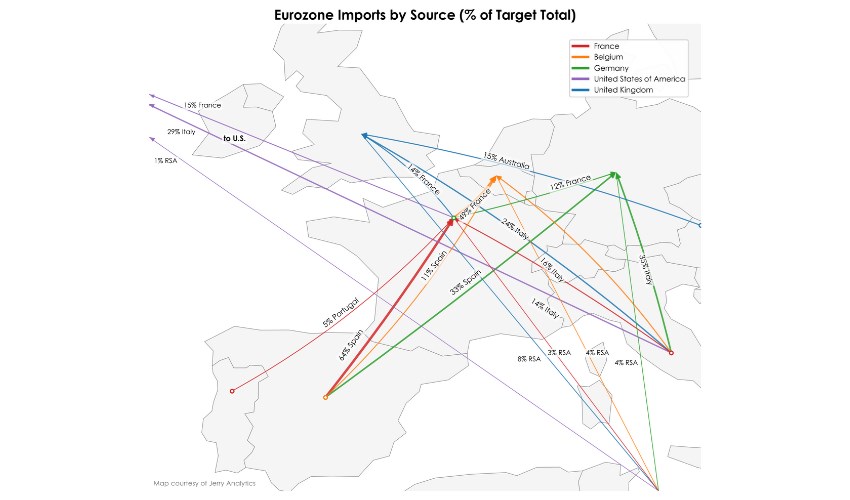
The map below shows the main countries that imported South African wine in 2024, namely the UK, Netherlands, Belgium, Germany, France, and the USA (South Africa is 13th biggest wine importer), along with information on where they source their wine and the percentage of their wine imports that comes from South Africa.
-
Germany: Italian wines surged in 2025, with exports up 10.3% in value and 1.8% in volume in the first half of the year. This recovery came at the expense of South African wines, which saw a 6% decline in exports to Germany. Italy exports 8 times more wine to Germany than South Africa exports to Germany.
-
United Kingdom: Italian exports fell 7.3%, but France and Italy still dominate the market. South African exports to the UK dropped 12%, squeezed by European producers. Although still South Africa’s biggest export market Italy and France still exports more than double each in volume wine to the UK.
-
France: South African exports to France collapsed by 28%, as domestic producers, unable to sell into the U.S., saturated their own market and reduced demand for imports. Exports to France is directly related to French production surplus.
-
Belgium: South African exports fell 4%, again reflecting heightened competition from redirected European supply.
South Africa’s European markets are now battlegrounds where French and Italian producers, desperate to maintain revenues, undercut competitors with aggressive pricing and increased volumes.
Explaining the decline in South African exports
The 8.2% overall decline in South African wine exports in 2025 can thus be explained by three interrelated dynamics:
-
Direct U.S. Tariffs: South African wines now face a 30% tariff in the U.S., leading to a 67% drop in exports to that market.
-
European Oversupply: France and Italy, locked out of the U.S., redirected their wines into Europe, intensifying competition in South Africa’s main markets (UK, Germany, France, Belgium).
-
Global Economic Slowdown: Sluggish Eurozone growth, U.S. inflation, and weaker consumer demand further reduced overall wine consumption.
The result is a perfect storm, South Africa is squeezed out of both the U.S. and Europe, with little room to manoeuvre.
Conclusion
The South African wine industry’s struggles in 2025 highlight the interconnected nature of global trade. Tariffs imposed on European producers in the U.S. reverberated across the Atlantic, reshaping competition in Europe and undermining South Africa’s export performance. France and Italy’s exposure to the U.S. market, combined with their dominance in Europe, meant that South Africa was caught in the crossfire of a trade war it was never meant to fight.
Looking ahead, South Africa must diversify its export markets, strengthen its presence in Asia and Africa, and invest in branding that differentiates its wines from European competitors. Otherwise, it will remain vulnerable to the ripple effects of global trade disputes. The lesson of 2025 is clear, in an interconnected industry, no producer is an island, and disruptions might not be as direct as expected.