When Tahiirah Habibi founded The Hue Society in 2017, an organization determined to revolutionize the Black, Brown, and Indigenous wine enjoyment e experience — no code-switching or assimilation required — she knew its message had to go global. It needed to go somewhere that epitomizes Black excellence and innovation. It needed to go to South Africa.
The seventh-largest producer of wine in the world, Africa’s southernmost country boasts long, balmy summers, wet winters, and well-drained soils — ideal conditions for Cabernet Sauvignon and Chenin Blanc, South Africa’s best-loved varietals.
But, as any wine lover knows, history and wine go hand-in-hand and South Africa’s history exemplifies just how complicated that relationship can be. The federal government’s segregationist policy, apartheid, which existed from 1948 to 1994, excluded non-white citizens from civic life, education, and socioeconomic advancement opportunities.
No industry typified this systemic exclusion more than the wine industry where Black laborers never saw the fruits of their labor, often being paid illegally with leftover wine instead of currency under the “dop” system which led to widespread, generational poverty.
Today, although most of South Africa’s 300 000-strong wine industry laborers are BIPOC, and though the wine industry is one of the most forward-thinking in the country — growers often surpass Fairtrade standards and utilize innovative sustainable production practices — fewer than 65 of the country’s 536 wineries are owned and operated by people of color. And fewer than 10 of those labels (roughly 2 percent) own the land on which their wines are produced.
“I wanted to shed light on what it means to be in that industry from their perspective,” Habibi says of The Hue Society’s first international chapter and the inspiration for this year’s Wine & Culture Fest. “Often, we assume that because South African wine is African, many of the winemakers must be people of color. However, only about 1 percent of people involved in the South African wine industry are Black,” Habibi says.
But that number is growing, and the shift in the industry is being led by a determined handful of BIPOC sommeliers, winemakers, and label owners determined to have their voices heard and their wine labels represented globally.
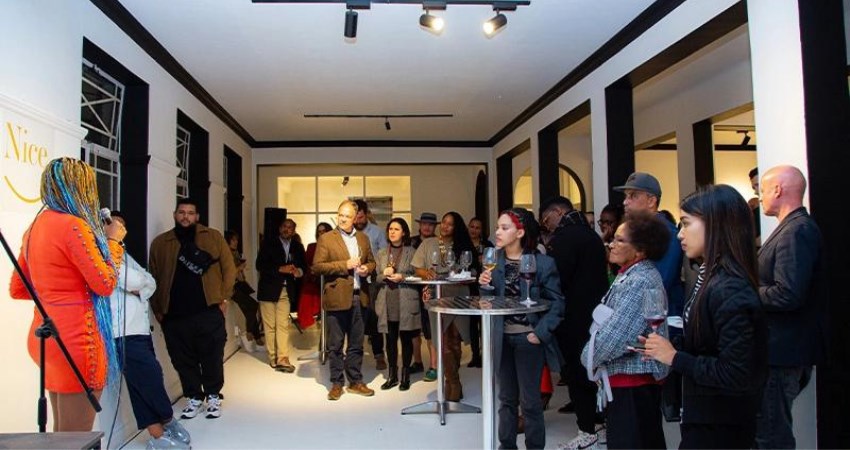
Tahiirah Habibi speaking at the launch of The Hue Society’s first international chapter, South Africa, held in collaboration with Nice Beverage Company in Cape Town.
Click HERE to read the full article.